7950 Legacy Drive, Suite 400, Plano, TX 75024
  469-375-9656
  info@planowebsitedesign.com







If you run a roofing business in 2026, here is the truth: referrals alone will not keep your calendar full. Homeowners search online before they call anyone. If your roofing company is not showing up in those searches, a competitor is taking the job that should have been yours.
This guide covers everything you need to know about roofing digital marketing, from local SEO and Google Ads to social media, reputation management, and AI-powered lead generation. Whether you are a solo contractor or a growing roofing company, this is the roadmap that will help you generate consistent leads, book more jobs, and outrank the competition.
Table of Contents
Why Digital Marketing for Roofing Companies Is No Longer Optional
The roofing industry is more competitive than ever. Roofing companies making $5M+ per year dominate search results and lock out smaller operators. The difference between them and everyone else is rarely workmanship. It is marketing.
Digital marketing is the present for Roofing Contractors. Platforms like Google and Facebook, once considered cutting-edge, are now mature spaces where contractors who are just beginning to invest must adjust their expectations and strategies accordingly.
More than 65% of roofing searches now occur on smartphones, particularly during emergency situations like storm damage. A site that loads slowly or displays poorly on mobile devices immediately sends potential customers to competitors.
The roofing companies winning right now are not the ones with the best warranties or the shiniest trucks. They are the ones that show up first when a homeowner types “roofing contractor near me” into Google. Digital marketing for roofing contractors is what makes that happen.
The Core Pillars of Roofing Digital Marketing
Before diving into specific tactics, it helps to understand the full ecosystem. Effective digital marketing for roofing companies rests on five core pillars:
- A high-converting roofing website
- Local SEO and Google Business Profile
- Paid advertising (PPC and Local Services Ads)
- Reputation management and online reviews
- Social media and content marketing
The four key pillars for roofing marketing success in 2026 are: being present on all major platforms, staying consistent, prioritizing organic content, and leveraging AI thoughtfully. Contractors who embrace these principles will be better positioned to stand out in an increasingly crowded digital landscape.
Let us break each of these down so you know exactly how to put them to work.
1. Build a Roofing Website That Converts, Not Just Impresses
Your website is your most important digital asset. It is the destination for every ad you run, every SEO ranking you earn, and every social media post you publish. A beautiful website that does not convert visitors into calls is a wasted investment.
Here is what a high-performing roofing website needs in 2026:
Speed and mobile optimization. Your site must load in under three seconds on mobile. Google uses mobile-first indexing, meaning your mobile experience directly affects your search rankings. A slow site loses both visitors and rankings.
Clear calls to action. Phone numbers should be visible in the header, clickable on mobile. Contact forms should be short name, phone, and a brief description of the project. The easier you make it to reach you, the more leads you will capture.
Trust signals. Display your licenses, insurance certificates, manufacturer certifications, and affiliations. Add real photos of your team and completed jobs. These details build the credibility that converts browsers into callers.
Service-specific landing pages. Create individual pages for roof replacement, roof repair, storm damage, commercial roofing, gutters, and any other service you offer. This structure helps search engines understand what you do and rank you for specific searches.
Your website serves as the digital front door to your business. It needs to make a strong first impression and quickly convert visitors into leads.
2. Local SEO for Roofing Contractors: How to Dominate Your Market
Local SEO for roofing contractors is the single most cost-effective way to generate long-term, consistent leads. When someone searches “roofing company [your city],” you want to appear in both the organic results and the local map pack (the three business listings shown at the top of search results).
Optimize Your Google Business Profile
Your Google Business Profile (GBP) is the centerpiece of local SEO. A fully optimized Google Business Profile should have “Roofing Contractor” as your primary category, with secondary categories like “Roof Repair Service” and “Gutter Installation Service.” You should upload job photos weekly and post regular updates and promotions.
Key optimization steps for your GBP:
- Use your exact business name, address, and phone number (NAP) consistently across all platforms
- Write a keyword-rich business description that naturally includes terms like “roofing contractor,” your city name, and your key services
- Add all your services with descriptions and pricing ranges where possible
- Respond to every review — positive and negative
- Post updates, project photos, and seasonal offers at least once a week
On-Page SEO for Roofing Companies
On-page SEO refers to the content and structure of your website pages. For roofing companies, this means:
Keyword targeting. Each service page should target a specific keyword, such as “roof replacement [city]” or “emergency roof repair [city].” Use the keyword naturally in the page title, headings, meta description, and throughout the body text.
Location pages. If you serve multiple cities or neighborhoods, create a dedicated page for each location. A page titled “Roofing Contractor in [City Name]” with locally relevant content will rank far better than a generic “Service Area” page.
Schema markup. Adding the LocalBusiness schema to your website tells search engines exactly what you do, where you are, and how to contact you. This structured data can improve your visibility in both traditional and AI-powered search results.
Internal linking. Connect your service pages and to your blog content. This helps search engines crawl your site and distribute ranking authority across your pages.
SEO for roofers is what will help your business stand out among hundreds of competitors. Without a proper digital marketing strategy, you will be fighting an uphill battle in this increasingly internet-oriented world.
Citations and Directory Listings
Increasing your visibility can be as simple as setting up a profile on sites like Angi, Yelp, Apple Business Connect, and LinkedIn Company Pages. Make sure your business name, address, and phone number are identical on every directory. Inconsistencies confuse search engines and hurt your local rankings.
3. Paid Advertising: Google Ads and Local Services Ads for Roofers
Roofing PPC (pay-per-click) advertising puts your business at the very top of Google search results, above organic listings and even the map pack. While SEO builds long-term visibility, PPC delivers immediate leads.
Google Ads for Roofing Contractors
Roofing clicks are expensive. In many markets, you will pay $10 to $30 per click, sometimes more after storms. That does not make PPC bad; it just means it has to be used strategically.
To run profitable Google Ads campaigns as a roofing contractor:
Focus on high-intent keywords. Terms like “roof replacement cost,” “emergency roofer near me,” and “roof leak repair [city]” signal that someone is ready to hire. Avoid broad, informational keywords that attract people doing research rather than those ready to buy.
Use negative keywords aggressively. Add “DIY,” “how to,” “free,” and “jobs” as negative keywords to prevent your ads from showing to people who will never call you.
Send ad traffic to dedicated landing pages. Do not send PPC traffic to your homepage. Create a dedicated landing page for each ad campaign that matches the ad’s message and has a single clear call to action.
Track calls and conversions. Set up call tracking so you know exactly which keywords and ads are generating phone calls. This data lets you cut wasted spend and double down on what works.
Google Local Services Ads (LSAs)
Local Services Ads appear above regular Google Ads and carry a “Google Guaranteed” badge. They work on a pay-per-lead model rather than pay-per-click, which can make them more cost-effective for roofing companies. To qualify, you must pass Google’s background check and verification process but the trust signal that badge provides is worth the effort.
4. Reputation Management: Online Reviews Are Your Most Powerful Marketing Tool
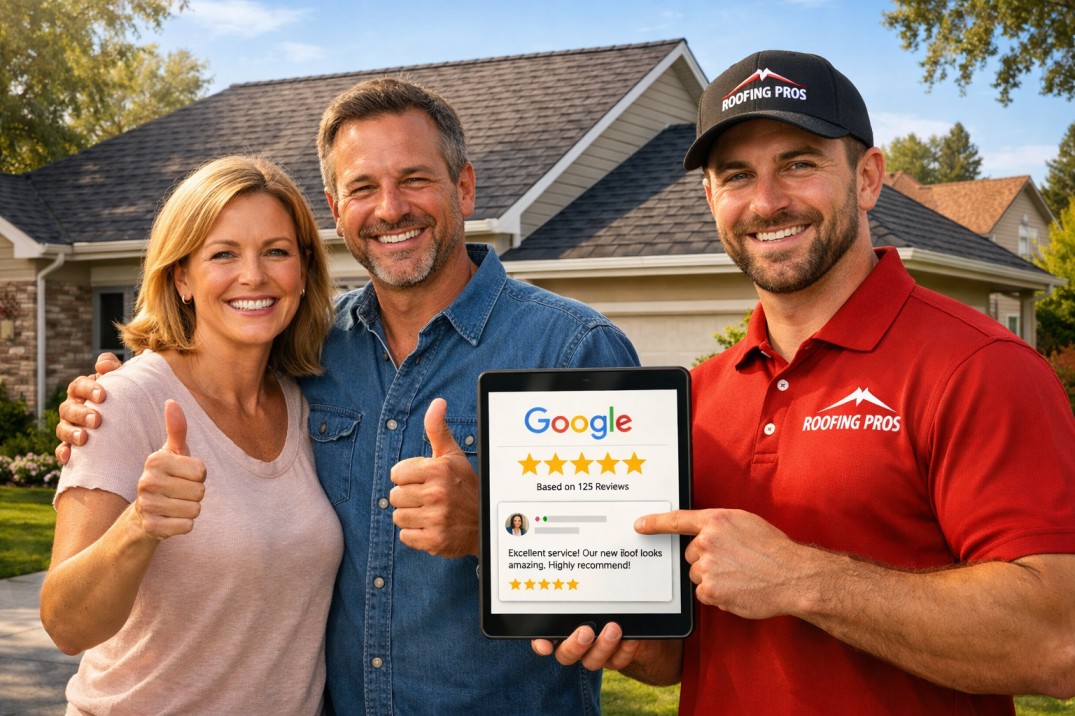
In roofing, trust is everything. Homeowners are making a $10,000 to $30,000 decision about their biggest asset. They will read your reviews before they call you.
Your online reputation is no longer just a nice-to-have; it is the bedrock upon which your entire marketing strategy rests. Before investing heavily in campaigns or the latest SEO techniques, you must ensure your foundation is solid and inspires trust.
How to Generate More Reviews
- Ask every satisfied customer for a review immediately after the job is complete, ideally in person, with a follow-up text that includes a direct link to your Google review page
- Train your crew to mention reviews at the end of every job
- Send an automated follow-up email or SMS two to three days after project completion
- Make the process frictionless by creating a short review link using Google’s review link generator
How to Respond to Reviews
Responding to every review tells Google your profile is active and tells potential customers that you care. For positive reviews, thank the customer by name and mention the service you provided. For negative reviews, respond calmly and professionally, acknowledge any concern, and offer to resolve the issue offline. Never argue in a public reply.
A roofing company with 150 four-star reviews will consistently outperform a company with 10 five-star reviews both in search rankings and customer trust.
5. Social Media Marketing for Roofing Companies
Social media is not where roofing leads are born, but it is where trust is built and brand awareness compounds. Used correctly, it supports your SEO, strengthens your reputation, and keeps your business top of mind.
Facebook and Instagram are the most effective channels for residential roofing. LinkedIn makes more sense for commercial work. Social platforms are best for awareness and credibility, not last-click conversions.
What to Post on Social Media as a Roofing Contractor
Before-and-after photos. Nothing sells roofing work like a dramatic transformation. Post side-by-side images with a brief caption describing the project, the materials used, and the city where the work was done.
Short video content. Walk through a job site and explain what you are doing and why. A 60-second Reel showing a roof tear-off or shingle installation gets far more engagement than a static image and builds enormous credibility.
Customer testimonials. Film short video testimonials on-site immediately after a job. Ask the customer what problem they had, how the experience went, and whether they would recommend you.
Educational content. Posts explaining how to spot roof damage, what questions to ask a roofer, or how the insurance claims process works position you as the trusted expert in your market.
Storm response posts. After a major storm in your service area, post immediately. Offer free inspections, explain the insurance process, and give homeowners a reason to call you first.
6. Content Marketing and Blogging for Roofing SEO
A roofing blog is one of the most underutilized tools in digital marketing for roofing companies. Well-written blog content drives organic traffic, builds authority, and supports your local SEO rankings.
Target questions your potential customers are actually searching for:
- “How long does a roof replacement take?”
- “What is the average cost of a new roof in [city]?”
- “How do I know if I need a roof repair or full replacement?”
- “Does homeowners’ insurance cover storm damage to my roof?”
Each of these questions represents a blog post that can attract homeowners at different stages of the buying journey. Over time, a library of 20 to 30 well-optimized posts can generate hundreds of monthly website visitors at zero ongoing cost.
For AI-powered search results, write content that directly and completely answers a specific question. Use clear headings, bullet points where appropriate, and include your city and service area throughout the content naturally.
7. AI and Emerging Technologies in Roofing Digital Marketing
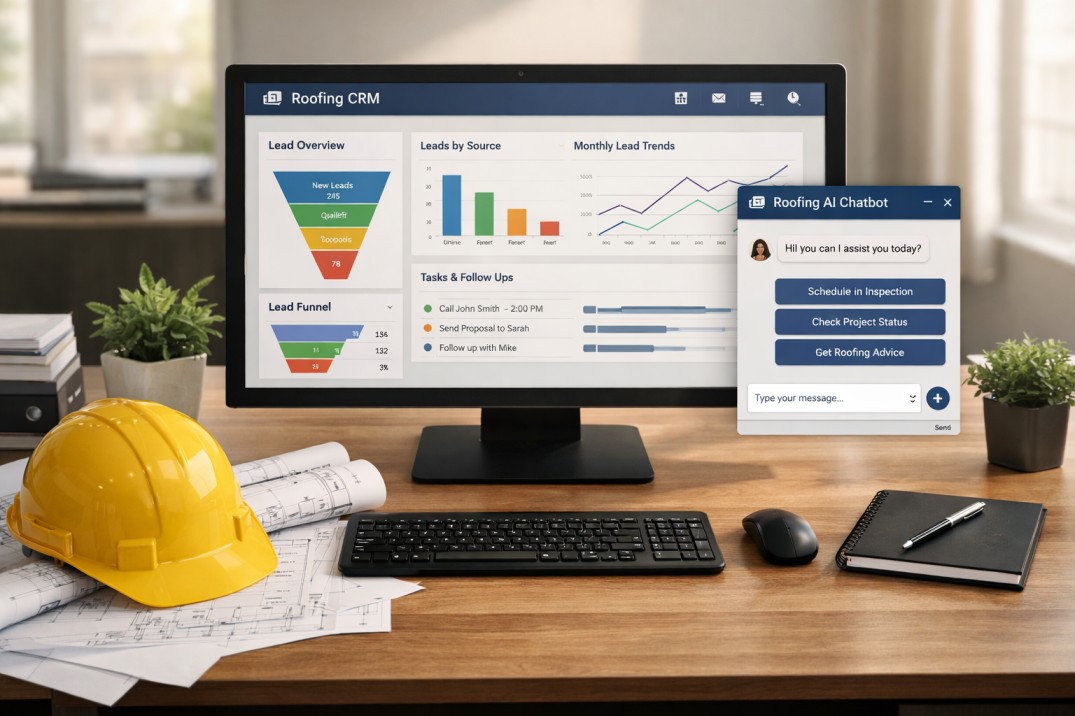
Artificial intelligence tools are transforming roofing digital marketing efficiency. AI-powered chatbots qualify leads and answer common questions 24/7. Predictive analytics identify the highest-value prospects. Automated bid management optimizes PPC campaigns continuously.
Here is how forward-thinking roofing companies are using AI in 2026:
AI chatbots on your website. A chatbot can engage visitors, collect contact information, and qualify leads around the clock, even when you are on the roof and cannot answer the phone. The best ones can answer pricing questions, schedule estimates, and escalate urgent requests automatically.
Voice search optimization. Voice search optimization is growing increasingly important as smart speakers and voice assistants become ubiquitous. Optimize for conversational, question-based queries like “Who is the best roofer near me?” rather than only focusing on traditional keyword phrases. Write your website content in a natural, conversational tone that mirrors how people actually speak.
AI-assisted content creation. Use AI tools to generate first drafts of blog posts, service page copy, and email sequences, then refine them with your own expertise and local knowledge. This speeds up content production without sacrificing quality.
Automated email and SMS follow-up. Set up automated sequences that follow up with leads who submitted a form but did not convert. A simple three-email sequence over seven days can recover a significant percentage of lost leads.
8. Roofing Lead Generation Services and When to Use Them
Third-party roofing lead generation services like Angi, HomeAdvisor, and Thumbtack can supplement your own digital marketing efforts. However, they come with a critical drawback: you are competing with multiple contractors for the same lead, which drives up costs and drives down margins.
The goal of your own digital marketing for roofing company should be to generate exclusive leads that come directly to you, not shared leads that go to your five nearest competitors simultaneously.
Use lead generation platforms early in your business when you need volume, but invest in your own SEO, website, and Google Ads in parallel. Over time, your owned channels will generate better-quality leads at a lower cost per acquisition.
9. Roofing Marketing for Different Business Types
Online Marketing for Small Roofing Businesses
For small roofing businesses with limited budgets, prioritize in this order: Google Business Profile optimization (free), online reviews (free), and a basic but mobile-optimized website. These three alone can generate meaningful leads without significant ad spend.
Affordable digital marketing for roofing companies does not mean cheap. It means smart allocation. Spend where the ROI is clearest before expanding into paid channels.
Digital Marketing for Residential Roofing Companies
Residential roofing marketing is relationship-driven. Focus heavily on reviews, social proof, neighborhood targeting, and before-and-after content. Consider running geo-targeted Facebook Ads within a radius of your recent job sites to build brand recognition in specific neighborhoods.
B2B Roofing Marketing Services
Commercial roofing requires a completely different approach. Your buyers are property managers, facility directors, and real estate developers, not homeowners. LinkedIn advertising, targeted email outreach, case studies, and commercial-specific landing pages are far more effective than residential-focused strategies. Longer sales cycles mean content that nurtures prospects over weeks or months is essential.
Marketing Services for Roofing Startups
New roofing companies need visibility fast. Prioritize your Google Business Profile, get your first 10 to 15 reviews from friends, family, and early customers, and run targeted Google Local Services Ads to generate early leads while you build your organic presence.
10. How to Choose the Right Roofing Digital Marketing Agency
If you decide to hire a roofing digital marketing agency rather than manage everything in-house, here is what to look for:
Roofing industry experience. A generalist marketing agency will have a steep learning curve. An agency that specializes in digital marketing for roofing contractors already understands the seasonality, competitive landscape, and customer psychology of your industry.
Transparent reporting. You should receive clear monthly reports showing exactly where your leads came from, what you spent, and what the return was. If an agency cannot or will not show you this data, walk away.
Ownership of your assets. You should own your website, your Google Ads account, and all your login credentials. Never work with an agency that retains ownership of your digital assets.
Proven results in your market. Ask for case studies or references from other roofing companies they have worked with. Specifically ask about lead volume, cost per lead, and ranking improvements.
No long-term lock-in contracts. A confident roofing digital marketing company will earn your business month after month. Be cautious of agencies requiring 12-month contracts with no performance guarantees.
Building Your Roofing Marketing Stack: A Practical Checklist
Here is a practical checklist to assess where you are and what to prioritize next:
Foundation (Do These First)
- Fully optimized Google Business Profile with photos and regular posts
- Mobile-optimized website that loads in under three seconds
- At least 25 Google reviews with responses
- Business listed on Yelp, Angi, Apple Business Connect, and BBB
- Call tracking is installed on your website
Growth (Next Priority)
- Service-specific landing pages with local keyword targeting
- Google Local Services Ads campaign is live
- Active social media presence (at a minimum, Facebook and Instagram)
- Blog with at least 10 locally targeted articles
- Email follow-up sequence for new leads
Scale (When You Are Ready)
- Google Ads campaigns for high-intent keywords
- AI chatbot on your website
- Video testimonial library
- Referral program with incentives
- Retargeting ads for website visitors who did not convert
Final Thoughts: Roofing Digital Marketing in 2026 Is a Long Game
In 2026, you need to fire on all cylinders: referrals, SEO, AI search optimization, social media, and more. Digital marketing is the best way to guarantee your business’s survival and protect your territory.
The roofing companies that will dominate their markets over the next five years are not waiting for the perfect moment to invest in digital marketing. They are building their online presence now, earning reviews consistently, and showing up every time a homeowner in their area searches for a roofer.
Roofing digital marketing services are not an expense. They are the engine that keeps your business growing year after year, independent of referrals, weather patterns, or word of mouth alone.
Start with your Google Business Profile. Build your website. Earn your reviews. Then layer in SEO, paid ads, and content marketing as your budget allows. Done consistently over 12 to 24 months, this approach will compound into a steady stream of inbound leads that your competitors simply cannot keep up with.