7950 Legacy Drive, Suite 400, Plano, TX 75024
  469-375-9656
  info@planowebsitedesign.com







TL;DR:To get more Google reviews without risking your listing, build a simple habit of asking every happy customer at the moment they are happiest, make leaving the review a two-tap process with your Business Profile short link or a QR code, and reply to every review you get. What you must not do has changed: incentives, review gating, and asking staff for a set number of reviews are prohibited by Google, and since October 2024, fake and incentivized reviews are also against federal law with civil-penalty exposure. This guide covers the compliant tactics that actually move the needle for a Plano business, and the popular ones that can now get you fined or delisted.
Table of Contents
Why This Is Worth Getting Right
Reviews are the closest thing a local business has to word of mouth at scale, and they do double duty: they persuade the person reading them, and they feed your ranking in the Google map pack. That makes getting more reviews one of the highest-impact things a Plano business can do. It also makes it one of the easiest to get wrong, because half the advice online quietly recommends tactics that are now against the rules.
Here is what this guide walks through: why reviews move both customers and rankings, the review tactics that crossed from discouraged to illegal in the last two years, a request workflow you can run without thinking about it, where to put the link, and how to handle the negative ones. The goal is a steady stream of genuine reviews that builds trust with customers and with Google, without putting the listing you depend on at risk.
What Reviews Actually Do For A Plano Business
Two separate things happen when you earn a review, and it helps to keep them apart.
The first is persuasion. People read reviews before they choose, and they read a lot of them. In BrightLocal’s 2026 Local Consumer Review Survey of 1,002 US adults, 97% said they read reviews for local businesses, 41% said they always do (up from 29% the year before), and 31% now use only businesses rated 4.5 stars or higher, according to BrightLocal. For a Plano homeowner deciding between two contractors, your review profile is often the tiebreaker before they ever call.
The second is ranking. Google is open about how it orders local results. It ranks them on relevance, distance, and prominence, and it states plainly that more reviews and positive ratings can help your business’s local ranking according to Google’s local ranking guidance. The same page says something worth memorizing: There’s no way to request or pay for a better local ranking on Google. Reviews are one of the few honest levers you have on the map pack, which is exactly why the shortcuts are so tempting and so risky.
The Tactics That Are Now Off Limits
This is the part most review guides get wrong, and getting it wrong can cost you the listing. The rules tightened in two waves.
Google’s own policy prohibits a specific set of moves. You cannot offer any incentive, money, discounts, gift cards, or free product in exchange for a review, or for changing a negative one. You cannot ask your staff to leave reviews or to hit a quota of them. And you cannot do review gating, the practice of surveying customers first and only routing the happy ones to Google while steering unhappy ones elsewhere, per Google’s review content policy.
The second wave is bigger, and almost no competing article mentions it. Since October 2024, fake and incentivized reviews are not just against Google’s terms; they are against federal law. The Federal Trade Commission’s rule banning fake and deceptive reviews carries civil penalties for businesses that knowingly break it (Federal Trade Commission). Everyone does it is not a defense against a federal rule. A promo that paid customers to post reviews felt clever in 2023; today it is real legal exposure.
There is a simple line that keeps you clear of all of it: ask anyone for an honest review, never pay for one, and never filter by sentiment. Soliciting a genuine, un-incentivized review is completely allowed and encouraged.
Why gating is the one that catches good businesses
Review gating deserves its own warning because it does not feel like cheating. A business owner installs a tool that asks “how was your experience?” and sends five-star customers to Google while catching complaints privately. It seems responsible. It is prohibited because it manufactures a rating that is higher than reality. Skip the filter. Ask everyone, and use the unhappy responses to fix the problem, not to hide it.
A Review Request Habit That Runs Itself
Most Plano businesses do not have a review problem so much as an asking problem. The customers are happy; nobody ever asks them at the right moment. Fix the moment and the volume follows.
The mechanics are easy. In your Google Business Profile, grab your short review link or generate a QR code, so leaving a review is two taps instead of a scavenger hunt. Then attach the ask to the point where satisfaction peaks:
- A home-service pro asks when the job is done, and the customer is standing there pleased with the work
- A med spa or dental office asks at checkout after a good visit, with a QR code at the desk
- A contractor sends one follow-up text with the link the evening the project wraps
Keep the ask personal and specific, and make it a routine, the same way you always send an invoice. The businesses that win at reviews are not the ones with the cleverest campaign. They are the ones who ask every satisfied customer, every time, at the moment it is natural.
One more habit that compounds: reply to your reviews. A short, human reply to a positive review shows the next reader you are engaged, and a calm reply to a negative one shows you handle problems. An active profile reads as a real, current business to customers and to Google alike, which is part of what our Google Business Profile optimization guide walks through in detail.
Where To Put Your Review Link So People Actually Use It
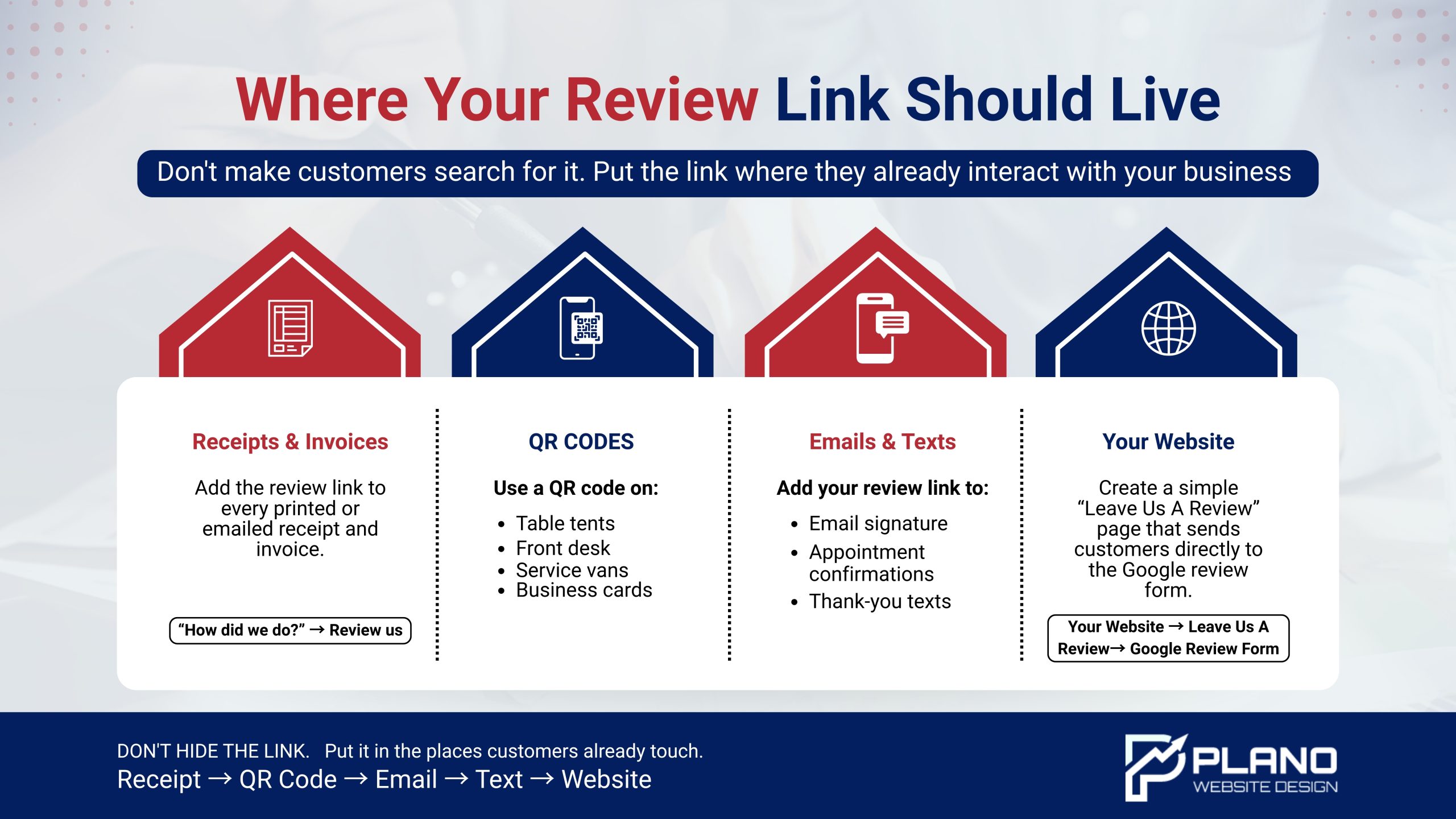
A review link that lives only in your head earns nothing. The businesses with hundreds of reviews are not lucky; they have simply put the link in front of people at a dozen small moments. Spread it across the places a customer already touches:
- On the printed or emailed receipt and the invoice, with a one-line how did we do?
- As a QR code on a table tent, the front desk, the service van, or the back of a business card
- In your email signature and your appointment-confirmation and thank-you texts
- On a leave us a review page on your own website that redirects to the Google form
The trick is not volume of channels for its own sake; it is meeting the customer where they already are. A dentist gets reviews from the checkout QR code. A plumber gets them from the text sent the moment the leak stops. A restaurant gets them from the table tent, not the website nobody visits after dinner. Pick the two or three moments that fit how your Plano business actually runs, and put the link there permanently.
How Many Reviews You Need, And How Fast
There is no magic number, and anyone quoting you one is guessing. What matters more than a total is the pattern. A profile that earns a few genuine reviews every week reads as a living business. A profile that sat dead for a year and then collected twenty in a weekend reads as manufactured, to customers and to Google’s spam systems alike.
So think in terms of a steady trickle, not a campaign. If you serve ten customers a week and ask every satisfied one, a healthy share will follow through, and within a season your profile looks active and current without a single risky shortcut. Recency matters too: a reader trusts a recent review far more than a glowing one from three years ago, so the habit of always asking keeps the top of your profile fresh on its own.
This is also where reviews stop being a standalone task and become part of local search engine optimization. Reviews feed prominence, prominence feeds the map pack, and the map pack feeds calls. A steady review habit sitting on top of an accurate profile and consistent business information is what our Plano Local SEO Services work is built to compound.
What A Good Review Ask Actually Sounds Like
The wording of the ask matters more than most owners think, and the compliant version is also the one that works best. You are not scripting what the customer should say, which is its own prohibited move; you are making it easy and specific for them to say what they already feel.
A weak ask is vague: leave us a review sometime. A strong ask names the moment and lowers the effort. For a home-service call, something like If you were happy with how the repair went today, a quick Google review really helps other Plano homeowners find us; here is the link, does three things at once. It ties the request to the fresh positive experience, it explains why it helps, and it hands over the link so there is nothing to hunt for.
Keep it human and keep it honest. Do not tell customers what to write, do not ask only the ones you know are thrilled, and do not dangle anything in return. Point them at the link, thank them, and let them speak for themselves. A specific, low-friction, no-strings ask made at the right moment converts far better than a generic blast, and it stays completely inside the rules while it does.
Handling The Negative Ones Without Panicking
A negative review is not the emergency it feels like. A perfect five-star wall actually reads as suspicious now, and a handful of honest three- and four-star reviews with thoughtful replies can build more trust than a flawless average.
When you get one, respond promptly, stay calm, and take the specifics offline. Thank them, acknowledge the issue, and offer to make it right by phone or email. You are not really writing to the reviewer; you are writing to every future customer who will read that exchange. Remember the rule that bites here: you cannot offer anything to have a negative review removed or revised. You can genuinely fix the problem and let the customer update their review on their own if they choose. If a review is fake or violates Google’s content policy, you can report it for removal, but you cannot buy your way out of it. One calm, fair reply to a hard review often does more for your reputation than the review itself took away, because the next reader watches how you handle pressure.
Where to go from here
Getting more Google reviews is not about a growth hack. It is a compliant habit: ask every happy customer at the right moment, make it effortless, reply to what comes in, and never cross the lines that Google and now federal law have drawn. Do that, and the reviews accumulate on their own, feeding both the customers reading them and your place in the map pack. If you would rather have the request system, the profile, and the local signals set up and running for you, the team at Plano Website Design can build the whole review engine so it stays compliant while it grows. Start asking this week, and give it a season to compound.