7950 Legacy Drive, Suite 400, Plano, TX 75024
  469-375-9656
  info@planowebsitedesign.com






Schema markup for AI search is structured code that tells AI systems exactly what your business is, what you offer, and where you operate, so they can read and cite you without guessing. For a local business, the types that matter most are LocalBusiness, Service, FAQPage, Article, and Organization for Plano local SEO, written in JSON-LD, the format every major AI engine relies on. Schema is not a ranking switch that vaults you to the top. It is a clarity signal. When Google, Bing, ChatGPT, and Perplexity can verify your facts cleanly, they are more willing to pull you into answers and cite you as a source. This guide covers which types to add, in what order, and the mistakes that make good markup useless.
Table of Contents
What You’ll Walk Away Knowing
Structured data has quietly become one of the few technical moves that pays off in the AI era, and most local businesses either skip it or install it wrong. That is the gap this guide closes.
Schema markup does one job well: it removes ambiguity. A person reading your site can infer that “we serve Plano and the surrounding area” means your service region. A machine wants that stated in code it can trust. Feed it that clarity, and you make yourself an easy business to cite.
By the end, you will know the handful of schema types a local business actually needs, the priority order to add them in, why JSON-LD is the only format worth using, how to check your markup is working, and the common WordPress setup that silently breaks the whole thing. No theory you cannot use, just the version that moves your AI visibility.
Why Schema Matters More In The AI Era
For years, schema markup earned you rich results, the star ratings, and FAQ dropdowns in Google. That still happens. What changed is that the same markup now feeds the AI systems deciding what to cite.
Both Google and Microsoft have said structured data helps their AI understand and verify content. Google’s search team has confirmed it gives an advantage, and Bing’s product lead has said schema helps their models read content for Copilot. Industry analysis through 2026 has repeatedly found that a large share of the pages AI tools cite carry structured data. The pattern is consistent enough to act on: markup does not guarantee a citation, but its absence makes you harder to trust and easier to skip.
The reason is simple. An AI model generating an answer wants to be right. It favors sources it can verify. Schema hands it verified facts, your name, your location, your services, your hours, in a form it does not have to interpret. Less interpretation means less risk, and less risk means the model is more comfortable naming you. That is the whole mechanism.
The Schema Types A Local Business Actually Needs
You do not need every schema type in the vocabulary. You need a small set, done correctly. Here is the priority order for a Plano service business.
| Schema type | What it tells AI | Priority |
| LocalBusiness | Who you are, where you are, hours, contact, service area | First, non-negotiable |
| Service | Each specific service you offer and who it is for | High |
| FAQPage | Direct question-and-answer pairs from your pages | High |
| Organization | Your brand entity, logo, and profiles that confirm you | Medium |
| Article | Blog posts and guides, with author and date | Medium, for content pages |
Start with LocalBusiness
If you add one thing, add the LocalBusiness schema. For any business tied to a place, this is the record that anchors everything: your exact name, address, phone, hours, and the areas you cover. It is the clearest signal that you are a real, locatable business, and it is the one AI systems lean on hardest for local recommendations. Get the details identical to your Google Business Profile and your website, because contradictions between them do more harm than missing markup.
Add service and FAQ schema next
Service schema lets you state each thing you sell as its own defined offering, which helps an AI match you to the specific question a customer asked. FAQPage schema marks up the real questions and answers on your pages so a model can lift them straight into an answer. These two are where a lot of citations come from, because they map cleanly to how people ask AI tools for help. Answer a real question in plain words, mark it up, and you have handed the model a ready-to-use response with your name attached.
Round it out with brand and content markup
Organization schema defines your brand as an entity and links the profiles that confirm it, which supports the consensus signals AI tools look for before they name you. Article schema goes on your blog posts and guides, carrying the author and date that help establish the content as credible. Neither is as urgent as LocalBusiness, but together they fill in the picture.
JSON-LD Is The Only Format That Matters
There are older ways to write schema inside your HTML tags. Skip them. JSON-LD is the format Google recommends and the one every major AI engine reads reliably, including Google, Bing, Perplexity, and the systems behind ChatGPT. It sits in a clean block in your page code, separate from your visible content, which makes it easier to manage and less likely to break when you edit the page.
The practical benefit for a local business is that JSON-LD keeps your markup in one readable place. You are not threading attributes through your paragraphs and hoping nothing gets knocked loose during a redesign. One block, all your facts, easy to audit. When we build sites at Plano Website Design, the structured data lives in JSON-LD for exactly this reason: it is the format the machines want and the format that survives real-world site edits.
How to Check Your Schema Is Actually Working
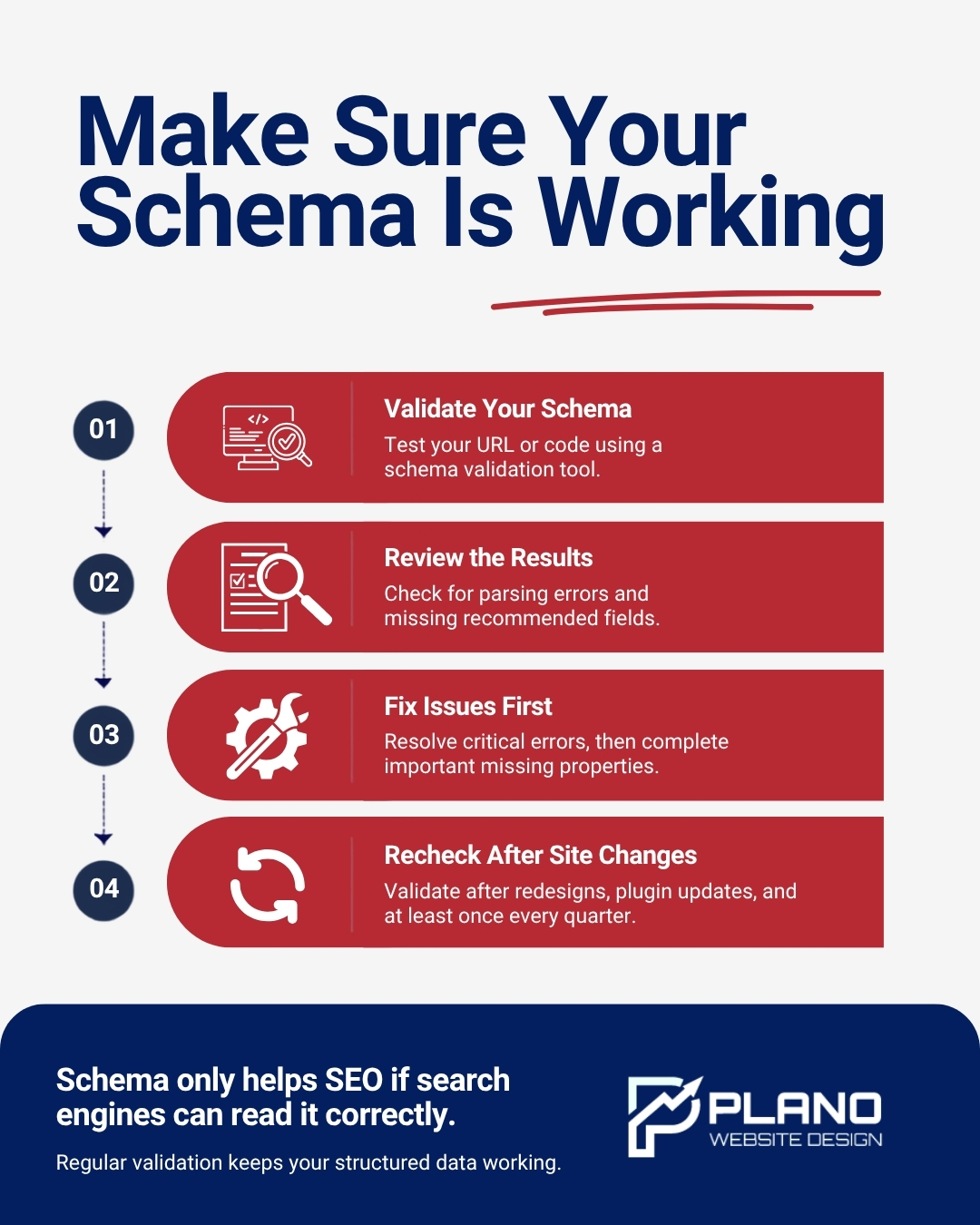
Adding markup is only half the job. You have to confirm a machine reads it the way you intended, because a small syntax slip can void the whole block.
Google’s Rich Results Test and the Schema Markup Validator both let you paste a URL or code and see exactly what the markup declares and whether it has errors. Run every important page through one of them after you add or change schema. Watch for two things: hard errors that stop the markup from parsing, and warnings where a recommended field is missing. Fix the errors first, then fill the gaps that matter for your business.
Do this again after any redesign or plugin update, since those are the moments when markup quietly breaks. A theme change can strip your LocalBusiness block without warning, and you will not notice from the front end because the schema is invisible to visitors. A quick validation check every quarter, and after any big site change, keeps your signals clean for the engines reading them.
The Setup Mistakes That Make Schema Useless
Good markup gets wasted more often than you would think. Watch for these.
The first is markup that contradicts your visible page or your Google Business Profile. Schema is a trust signal, and a claim in your code that disagrees with what a human sees on the page is worse than no markup at all. If your schema says you are open until 8 and your site footer says 6, you just taught the machine you are unreliable. Every source has to tell the same story.
The second is inventing FAQ content just to have the FAQPage schema. Google’s guidelines are clear that markup should reflect real content actually on the page. Padding a page with fake questions to farm rich results is the kind of scaled, search-first move that gets down-weighted. Mark up the questions your customers really ask, answered honestly.
Third is the WordPress trap. Many themes and SEO plugins output their own schema, and when you add a second source on top, you can end up with duplicate or conflicting markup fighting itself. Before you add anything, check what your theme and plugins already produce. One clean, correct set beats three overlapping ones.
The last mistake is treating schema as the whole job. Markup makes your content readable, but the content still has to be worth reading. Structured data on a thin page just clearly labels a thin page. Pair it with real depth, and pair it with the other signals that get you named, which we cover in our guide to getting your business recommended by ChatGPT.
What A Complete Setup Looks Like For One Business
To make this concrete, picture a Plano HVAC company doing it properly. On the homepage and contact page sits a LocalBusiness block with the exact business name, the physical address, the phone number, the real hours, and the service area listed as Plano and the surrounding Collin County cities. That single block matches their Google Business Profile field for field, so a machine cross-checking the two finds no contradiction.
On each service page, a Service block names the offering plainly, air conditioning repair, furnace replacement, seasonal maintenance, and ties it back to the business. The frequently asked questions on those pages carry FAQPage markup, so when a customer asks an AI “how much does an AC tune-up cost in Plano”, the model has a clean, quotable answer with the company attached. An Organization block on the site links to their verified profiles, and each blog post uses Article markup with a real author and date.
None of that is exotic. There are five schema types, placed where the content earns them, kept in JSON-LD, and validated after setup. The result is a site where every important fact is stated in code a machine can trust, which is exactly the condition that makes an AI comfortable pulling the business into an answer. A competitor with richer marketing but messy or missing markup often loses this quiet contest, because the AI has to guess about them and does not have to guess about the HVAC company.
The lesson for any local business is that the winner here is often the one who simply made themselves the easiest to read.
How Schema Fits The Bigger AI Search Picture
It helps to keep the schema in proportion. It is one lever among several, and it works best as part of a connected plan. Structured data supports answer engine optimization by making your FAQ and service content extractable, and it supports generative engine optimization by giving AI tools verified facts to cite. For the full map of how these pieces fit, our comparison of AEO vs SEO vs GEO shows where markup sits in the order of operations.
The honest framing: schema will not carry a weak site, but a strong site without it is leaving clarity on the table. Every fact you leave to a machine’s interpretation is a fact it might get wrong or decide not to trust. For a local business trying to get read and cited by AI, that clarity is cheap to add and hard to fake, which is exactly why it is worth doing right.
Bringing it all together
Schema markup for AI search comes down to one idea: state your facts in code so machines never have to guess. Start with LocalBusiness, add Service and FAQPage where your content earns them, keep everything in JSON-LD, and make sure it matches your site and your Google Business Profile down to the phone number. Then check that your theme is not already outputting conflicting markup, and validate the pages after every change. Do that and you turn your pages into something an AI can read, verify, and cite with confidence. If you would rather have the structured data built and checked for you, Plano Website Design sets it up as part of every site, so your business reads cleanly to Google and the AI tools alike.