 7950 Legacy Drive, Suite 400, Plano, TX 75024
  469-375-9656
  info@planowebsitedesign.com







Answer Engine Optimization is the practice of structuring your content and your business information so an AI system can pull a direct answer out of it and name you as the source. That is the whole definition. The part worth sitting with is the second half, because naming you as the source is a different outcome than ranking, and it takes different work to earn.
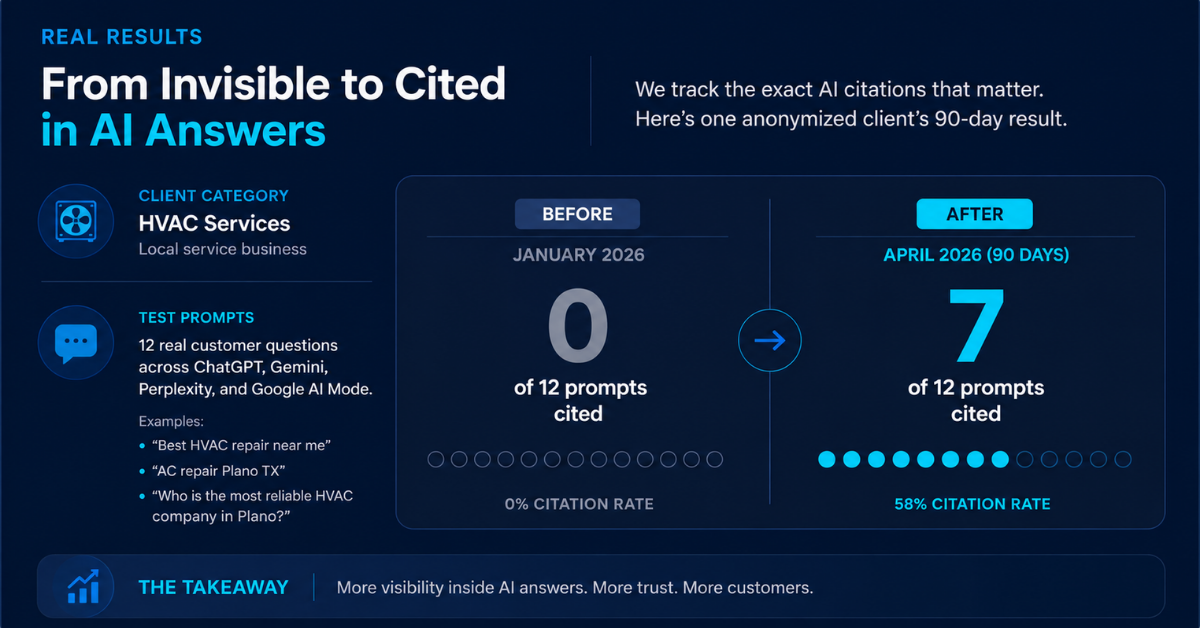
Here is why it landed on your desk this year. Consumer use of AI to find local businesses went from 6 percent to 45 percent in twelve months, which makes AI the third most-used discovery channel for local businesses behind only Google and Facebook. It has already passed Yelp and TripAdvisor. Adults between 30 and 44 lead the shift, with 64 percent having asked an AI tool for a business recommendation in the past year. When somebody asks ChatGPT for a good roofer near them, a recommendation gets made before anyone clicks anything. A business gets named. Usually the owner of that business has no idea it happened, and neither do the four businesses that did not get named.
Table of Contents
The number that should worry you
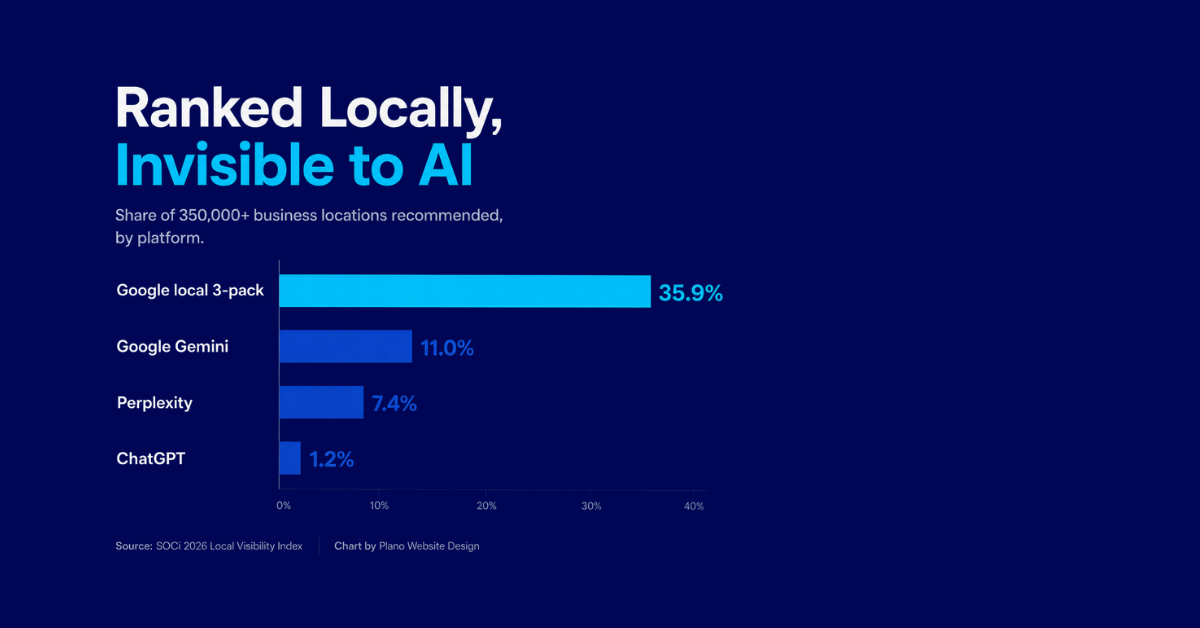
Ranking well locally does not carry over. SOCi’s 2026 Local Visibility Index looked at more than 350,000 business locations and found that only 1.2 percent were recommended by ChatGPT, against 35.9 percent that appeared in Google’s local 3-pack. Gemini recommended 11 percent. Perplexity, 7.4 percent.
Read that gap carefully. These are businesses that already won at local SEO. Most of them are invisible in the channel their buyers are moving to, and almost none of them know it.
What an answer engine does that a search engine does not
A search engine retrieves. You give it a query, it hands back a ranked list of places the answer might live, and you do the rest of the work yourself.
An answer engine synthesizes. It reads across sources, resolves them against each other, writes one response, and attaches citations to the claims it makes. The person reads the answer. Sometimes they click a citation. Frequently they do not, because they already got what they came for.
That shift changes what winning looks like. On a results page, ten businesses get a shot at the click, and page two exists. Inside a generated answer, the model typically names two or three, and there is no page two.
It also changes who you are writing for. A results page rewards a page that looks relevant to a query. An answer engine rewards a passage it can lift cleanly, check against a second source, and stand behind in front of a user. Vague marketing language does not survive that process. A specific, checkable statement does.
AEO and SEO share a foundation and end in different places
Nobody needs to throw out their SEO program. Google’s worldwide search share stood at 90.46 percent in May 2026, after peaking at 93.37 percent in February 2023 and bottoming at 89.35 percent in October 2024. The dip and the recovery are both less interesting than what happened inside the results page.
Google did not lose the search market. Google absorbed the answer engine. AI Mode crossed a billion monthly users and query length tripled inside Google’s own results page. The traffic is still arriving at Google. It is arriving at a version of Google that answers the question and cites three businesses instead of listing ten.
So the work overlaps heavily. Crawlability, page speed, accurate business information, internal linking and real content depth serve both. The difference sits at the finish line.
| SEO | AEO | |
|---|---|---|
| Competes for | A position on a page of links | A sentence inside a generated answer |
| Question it answers | Does this page deserve to rank? | Can a machine extract a correct, attributable answer from this page? |
| Primary surface | Organic results, Map Pack | ChatGPT, Perplexity, Google AI Mode and AI Overviews, Gemini, Copilot |
| Measured in | Positions, sessions, calls | Mentions, citations, answer presence |
| Shared foundation | Crawlable site, accurate business data, page speed, content depth, internal links | Same |
| Where most sites fail | Thin content, technical debt | No structured data, inconsistent entity data, nothing written to be quoted |
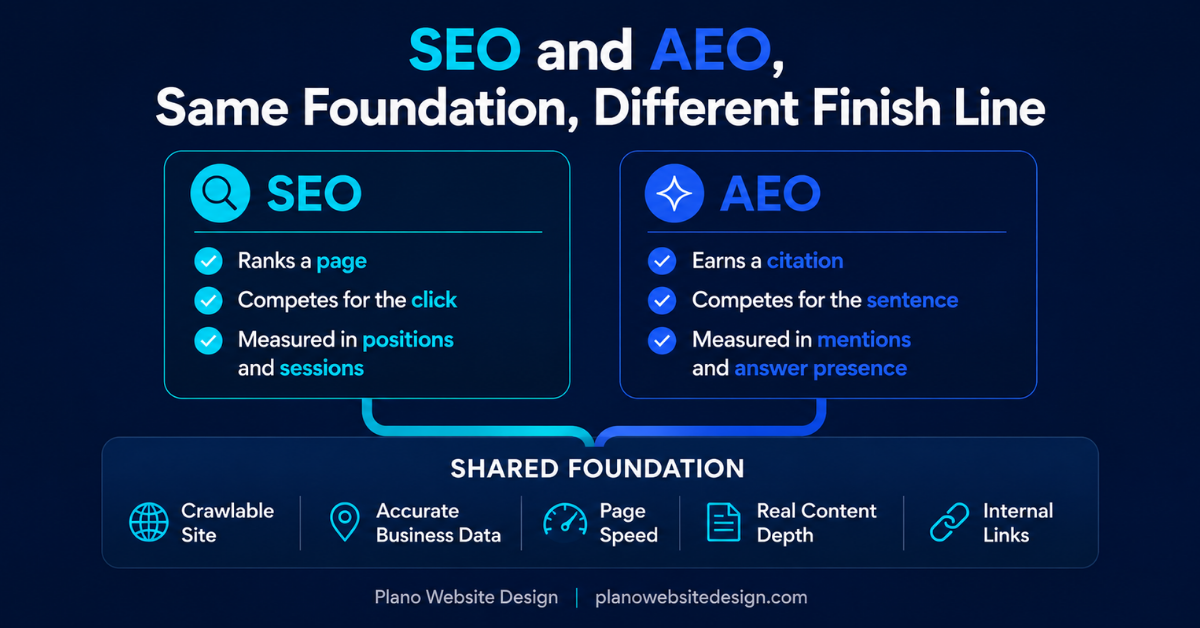
SEO asks whether a page deserves to rank for a query. AEO asks whether a machine can extract a correct, attributable answer from that page, and whether anything else on the internet backs it up. That second question is where most sites come up short, and it is rarely because the site is bad. It is because nobody wrote the page to be quoted.
AEO or GEO? The distinction that actually matters
You will see both terms. Generative Engine Optimization tends to describe the broader practice of showing up well across any generative system, including brand mentions inside answers that carry no link at all. Answer Engine Optimization tends to describe the narrower job of getting a specific question answered with your business named as the source.
In practice the work overlaps almost entirely, and arguing about the labels is a way to avoid doing either. We run Generative Engine Optimization and Answer Engine Optimization as distinct services because the deliverables differ: GEO leans on off-site presence and unlinked mentions, AEO leans on your own site’s structure and answer content. Most clients need both, weighted toward whichever side is currently weaker.
How AI systems decide which businesses to cite
BrightLocal’s 2025 analysis ran 20 searches across 10 industry niches, repeating each on Google AI Mode, Gemini, Perplexity and ChatGPT Search, then collecting every source the systems listed. Small sample, consistent picture. Every one of the large language models tested used directories and citations for business information across every industry, and Yelp turned up as a source in 33 percent of the searches overall. Perplexity used Yelp in every single industry investigated. Gemini was the only model that did not cite Yelp directly.
Two findings from that study deserve more attention than they got.
The first is reassuring. In BrightLocal’s earlier ChatGPT source study, business websites were used as a source 58 percent of the time, and the vast majority of sources across every model and industry were the businesses’ own websites. Your site is still the primary document. It just has to be readable.
The second is strange enough that most agencies have not caught up to it. Foursquare partnered directly with ChatGPT, and reports suggest that between 60 and 70 percent of local results on ChatGPT come from Foursquare’s city guide listings, particularly for smaller towns and niche businesses. Foursquare has largely retired its consumer-facing apps, and its database of more than 100 million points of interest across 200-plus countries is now feeding an AI most people assume runs on Google data.
If you have never claimed your Foursquare listing, that is a free afternoon with real upside. We check it on every audit and it is wrong or missing more often than any other listing.
Six signals do most of the work in deciding who gets named.
- Entity clarity. The system needs to know what your business is, where it operates, and what it sells, stated the same way everywhere it looks. This fails more often than owners expect. Only 68 percent of business contact information appearing on ChatGPT and Perplexity matches the details on the business’s own Google Business Profile. Roughly a third of businesses are being described to strangers with wrong information right now.
- Corroboration across sources. Answer engines cross-reference. One well-written page saying you are the best commercial electrician in the metroplex counts for nothing. That same claim reflected in a directory profile, a review platform, a video and a third-party listing starts to look like a fact.
- Reviews as structured trust. Review data is abundant, structured and directly evaluable by a machine, which is a large part of why Yelp shows up so often. Models pull Yelp not only for business details but to surface and summarize the reviews themselves. Volume, recency, and whether you actually respond all feed the read.
- Recency and activity. A profile that has not been touched in eight months reads as possibly stale, possibly closed. Regular posts, current photos and answered questions signal that the business is operating.
- Content written as answers. Pages built to describe what a company does get skipped in favor of pages built to answer what a buyer asked. This is the practical core of AEO.
- Machine-readable structure. Schema markup, clean heading hierarchy, and content that does not require a browser to render. If a model has to guess at your structure, it will usually quote a competitor who made it obvious.
What a citation is actually worth
The raw volume coming out of AI answers is smaller than the volume coming out of organic search, and it will stay smaller for a while. Anyone telling you to shift your budget wholesale is guessing.
The intent is a different matter. Somebody who reads an AI answer naming three businesses and clicks yours has already been filtered. They asked a specific question, they got a specific recommendation, and they arrived with the endorsement of a system they were already trusting to be neutral. That is a warmer arrival than a tenth-position organic click.
There is also a second return worth understanding. The work that makes you citable, meaning consistent entity data, structured markup, real reviews, and answer-shaped content, is the same work that improves conventional rankings and local pack presence. You are rarely trading one for the other.
What we will not do is promise you a citation by a particular date. Nobody controls what a model surfaces, and any agency guaranteeing it is selling you something it does not own. What can be done is closing every gap that keeps you out, then measuring what shows up.
Want to know which AI engines currently mention your business and which ones describe it wrong? Get your free AI Search & SEO Audit or call 469-375-9656.
Your Google Business Profile is doing double duty now
For a local business, the Google Business Profile has been the center of local visibility for years. It has quietly picked up a second job.
Google’s own AI models heavily favor Business Profile listings. Even where the profile was not the main cited source, AI Mode still displayed Business Profile information inside its results, often summarizing key details in text before showing the full listing further down. What surprises most owners is that platforms Google did not build pull from it too, because it is one of the most structured and authoritative repositories of local business information that exists.
The practical consequence is that a complete, active, information-rich profile stopped being a Google tactic. It is now the foundation layer for visibility across a growing set of interfaces at the same time. Treat it as a live content channel with posts, current photos, populated services and answered questions, rather than a listing you filled out once.
Reviews deserve their own line here. They are the fastest-moving trust signal available to a local business, they are read by both the ranking system and the human doing the scanning, and unlike time in the market they can be improved in weeks rather than years.
Third-party listings carry more weight than they did five years ago
Ask an answer engine for the best provider in a category and city and watch where the citations come from. Frequently they come from the aggregators. In BrightLocal’s dentistry searches, ChatGPT sourced information exclusively from ten different dental directories, with toprateddentist.com appearing across Gemini, AI Mode and ChatGPT. For legal queries, Superlawyers.com and Findlaw.com were heavily relied on by both ChatGPT and Perplexity. MapQuest turned up frequently for Google AI Mode and Perplexity.
That creates an uncomfortable situation for good businesses with thin directory footprints. You can be the strongest operator in your market and be functionally absent from the sources that get quoted when somebody asks who the strongest operator is.
Fixing it is unglamorous and effective. Claim and complete the listings that matter in your category, keep the information identical to your site and your Google profile, and add the third-party proof you have already earned. Our own work carries a 4.9 out of 5 on Clutch across 24 reviews and a 5.0 out of 5 on Google Business Profile across 18 reviews, and those profiles do more for our visibility in AI answers than any single page on our website does.
Answer-first writing, in practice
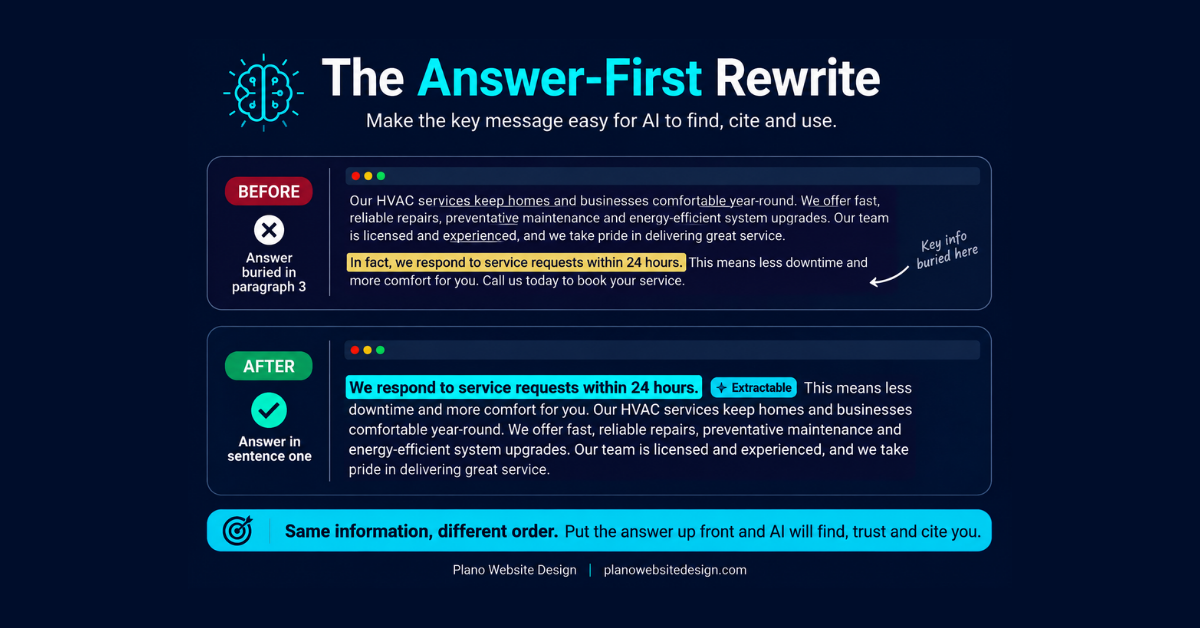
Most service pages open with a warm-up. A sentence about how important the topic is, a sentence about how confusing the market has become, then eventually the answer. That structure was tuned for a reader who had already clicked and was willing to scroll.
Answer-first writing inverts it. The direct answer goes in the first sentence, then the context, then the nuance. A model extracting a quotable passage finds one immediately. A human skimming on a phone finds one immediately too, which is the part people forget. This is better writing, and the machine benefit is a side effect.
A short example. An HVAC company writing about system replacement might open with a paragraph on how Texas summers strain equipment. Rewritten answer-first, the same page opens with the plain answer: most residential air conditioning systems need replacement between twelve and fifteen years, and the practical signals are rising energy bills, uneven cooling between rooms, and repair costs climbing past half the cost of a new unit. Everything else still gets said. It just gets said after the thing the reader asked about.
Apply the same discipline to headings. Use statements for most of them and questions for a few, matched to how people actually phrase things out loud, because voice and conversational queries are a meaningful share of what these systems see.
The structured data layer most websites are missing
Schema markup is the part of AEO that gets skipped most often, because it is invisible on the page and nobody complains about its absence.
In plain terms, schema is a labeled version of your page written for machines. It states that this string is a business name, this one is an address, this is a service, this is a question and this is its answer. A model reading marked-up content does not have to infer anything, and inference is where you lose.
For a local service business, four types do most of the lifting. LocalBusiness or Organization markup establishes the entity, the address and the hours. Service markup describes what you sell. FAQPage markup turns a question and answer section into something directly quotable. And sameAs properties connect your site to your verified profiles elsewhere, which is how a system confirms that the business on your website and the business on that directory listing are the same company.
One caution worth stating, because it comes up on nearly every audit we run. Having a visible FAQ section on the page is not the same as emitting FAQPage markup. Plenty of sites have the content and none of the structure, which means the work is already done and going unread.
One more thing people ask about. You may have heard about llms.txt, a proposed file that tells AI crawlers how to read your site. Current evidence suggests it does very little for citation rates, and the signals that actually move the needle are domain authority, structured data, review platform presence and third-party mentions. Add it if you like, it costs nothing. Do not let anyone sell it to you as a strategy.
What the free AI Search and SEO Audit actually looks at
The phrase free audit gets used loosely in this industry and usually means a scraped PDF, so here is what ours covers.
The audit is a diagnostic across four areas. First, technical readiness: whether your site is crawlable by AI systems, whether structured data is genuinely being emitted rather than merely displayed, and whether page performance is holding anything back. Second, entity consistency: whether your name, address, phone number and service descriptions match across your website, your Google Business Profile, Foursquare, Apple Maps and the directories in your category. Third, content shape: whether your pages answer the questions your buyers actually search, or only describe your services. Fourth, presence: where you currently show up in conventional results and whether you appear in AI answers for your own category and market.
What comes back is a plain-English read on where the gaps are, in the order they are worth closing, along with what each one would take. No ranking guarantees, because we do not make them. Some of what we find is fixable by your own team in an afternoon, and we will say so when that is true.
The audit is free and it is a real diagnostic, not a sales artifact with a discount at the bottom.
AEO is maintained, not installed
This is the expectation most likely to cause disappointment if nobody sets it early. Answer engine optimization is not a project with a completion date.
Models change. Their sources change. Competitors publish, earn reviews and claim listings. A profile that reads as current in March reads as neglected by October if nobody touches it. The businesses that stay visible are the ones running a maintenance rhythm, and the rhythm is not complicated.
- Weekly: publish something to your Google Business Profile, respond to every new review, and check that nothing has changed on your listings without your knowledge.
- Monthly: publish at least one answer-first piece targeting a real question your buyers ask, then check whether your business appears in AI answers for two or three queries you care about.
- Quarterly: re-verify structured data, audit your directory listings for drift, refresh photos, and review which queries are actually producing calls and forms.
- Annually: revisit the service descriptions and the questions themselves, because what buyers ask changes faster than what businesses say.
None of this requires a large team. It requires somebody to own it on a calendar. The failure mode is almost never effort. It is that the work has no owner.
Who this matters most for right now
Answer engine optimization is not equally urgent for every business. It moves first and hardest in categories where buyers ask for a recommendation rather than browsing for one.
Home services sit at the front of that line. Roofing, HVAC, plumbing, electrical, remodeling: high urgency, high trust requirement, and a buyer frequently asking a device for a recommendation while standing in the problem. Healthcare and dental practices are close behind, and the BrightLocal dentistry finding shows why. When ChatGPT pulls exclusively from dental directories for a search in your category, your website is not the battleground. Your directory footprint is. Legal and financial services face the same pattern through Superlawyers and FindLaw, with the added stake that accuracy of what a model repeats about you genuinely matters.
Multi-location operators have the largest problem and the largest payoff, because the consistency issue multiplies with every location and so does the return on solving it once at the data level. Professional and B2B buyers are already using these tools to build vendor shortlists before a single conversation happens. Retail and showroom businesses live or die on whether inventory, hours, and location accuracy feed a nearby-and-open query correctly.
If your business sits outside those categories, the foundation work still pays. It just pays through conventional search first and through answers second.
Serving Plano and the wider Dallas Fort Worth area
We work from 7950 Legacy Drive, Suite 400, Plano, TX 75024, and most of our clients are within a short drive. Local knowledge matters more in this work than it sounds like it should, because a search for a service in Frisco behaves differently than the same search in Plano, and knowing which surrounding cities actually send business your way changes where the effort goes.
Communities we regularly serve across the metroplex:
- Plano, Richardson and Allen
- Frisco, McKinney and Prosper
- Lewisville, The Colony and Little Elm
- The broader Dallas Fort Worth metroplex
For businesses operating in more than one of these markets, the work is largely the same with one addition: each location needs its own clearly defined entity and its own answer-shaped content, or the systems reading you will blur them together and describe you inaccurately in both.
How to check where you stand today
You can run a rough version of this yourself in about ten minutes, and it is worth doing before you talk to anyone, including us.
- Open ChatGPT or Perplexity and ask it to recommend a business in your category in your city, phrased the way a customer would phrase it out loud.
- Note who gets named. If you are not in the list, look at who is and check what they have that you do not, starting with review count and directory presence.
- Ask the same tool to describe your business by name. Read what comes back closely. Wrong hours, an old address or a service you dropped two years ago all point to entity data that needs cleaning.
- Search your own business name in Google and compare the information in your Business Profile against your website and your top three directory listings, field by field.
- Look yourself up on Foursquare. Most owners have never checked, and ChatGPT may be reading it before it reads your site.
- Open your highest-value service page and read the first sentence. If it does not answer the question that page exists to answer, you have found your first rewrite.
What that exercise gives you is a symptom list. What it does not give you is the cause, which usually sits in the technical layer where structured data either is or is not being emitted.
Where to start
If you want a complete read on how your business appears across conventional search and AI answers, and a prioritized list of what to close first, request the free AI Search & SEO Audit. We will show you what we find, in plain language, including the parts you can fix without us. You can also reach the team directly at 469-375-9656.

