7950 Legacy Drive, Suite 400, Plano, TX 75024
  469-375-9656
  info@planowebsitedesign.com







TL;DR
Decades in business is one of the most powerful trust signals a McKinney company can have, and most established businesses leave it almost entirely offline. History, awards, generations of customers, community roots: all invisible to Google, AI engines, and the newcomers flooding into town. Here’s how to turn heritage into structured, searchable, citable proof—without bragging.
Table of Contents
The Newcomer Problem
McKinney is adding households at a pace that reshuffles every customer base in town. The family that just closed in Trinity Falls doesn’t know that your shop has sponsored half the Little League teams since 2009, or that three generations have run the firm, or that locals wouldn’t dream of going anywhere else. They know what Google and ChatGPT tell them, and for most established McKinney businesses, that’s a name, an address, and a handful of reviews. The deepest reputations in town routinely lose newcomers to two-year-old competitors with better-structured websites. Not fair. Completely fixable.
Why Heritage Doesn’t Transfer Automatically
Reputation lives in human memory; search and AI run on documents. If the founding story, the years of service, the awards, and the community work exist only in customers’ heads and a framed clipping by the register, then as far as the digital layer is concerned, they don’t exist. This is the quiet asymmetry of the moment: new businesses must build trust from nothing, while established ones merely have to transcribe trust they already earned. Transcription is much easier, but someone has to actually do it.
Tell the Story Where Machines Can Read It
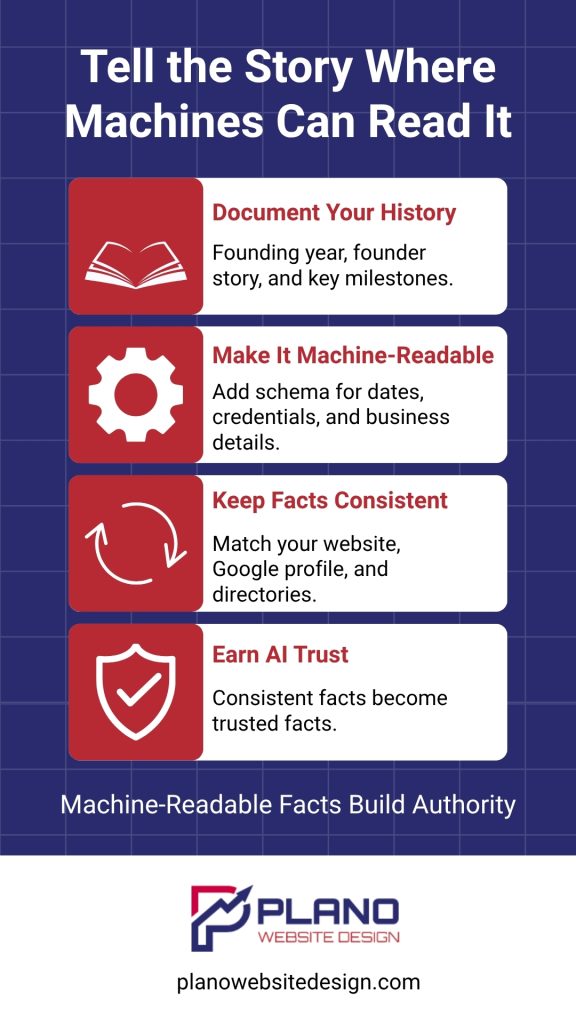
Start with the structural layer: a real About page with the founding year, the family or founder story, and the milestones written in plain language, because plain language is what AI engines quote. Mark up the founding date and credentials in schema so “serving McKinney since 2003” is a machine-readable fact, not a slogan. Get the history into your Google profile description. Make sure the timeline is consistent everywhere; a site that says 2003 and a directory that says 2009 read as doubt, not depth. This structural work is the heart of our McKinney AEO program, where heritage businesses see some of the fastest wins in the city.
Proof Beats Claims: Documenting the Years
“Trusted for 20 years” is a claim; proof is what ranks and persuades. Photograph the wall of awards and put each on the site with its year. Write up the long-running community involvement, the sponsorships, the chamber decades, and the school partnerships as dated, factual entries. Ask your oldest customers for reviews that mention how long they’ve been coming; a review that says “our family has used them since the kids were small” does more for a newcomer’s trust than any tagline. Longevity is only persuasive when it’s specific.
The Heritage Content Nobody Writes
Established businesses sit on content gold they never mine: how the square has changed since you opened, what twenty years of Texas storms taught you about roofs, and the customer stories with decades of arc. This material does triple duty: it’s genuinely interesting (rare in local content), it’s unfakeable E-E-A-T (no new competitor can write it), and it earns the local links and mentions that newer businesses pay agencies to chase. One well-told piece of institutional memory outperforms a year of generic blog posts. If the website itself is too dated to carry the story, modernize it without losing what the years built, then tell it.
Want to see how much of your reputation is actually visible online? The free AI Search & SEO Audit shows what Google and AI currently know about you and don’t know. Call 469-375-9656.