7950 Legacy Drive, Suite 400, Plano, TX 75024
  469-375-9656
  info@planowebsitedesign.com






The short answer on web designer vs web developer: hire a designer when the problem is how your site looks and guides visitors, and a developer when the problem is what the site has to do behind the scenes, such as taking bookings or moving to a new platform. Most small business sites in Plano need a bit of both, which is why the better question is usually who can cover both jobs for your project. The federal government’s own job descriptions for the two roles overlap more than most people expect, and that overlap is a good place to start.
TL;DR
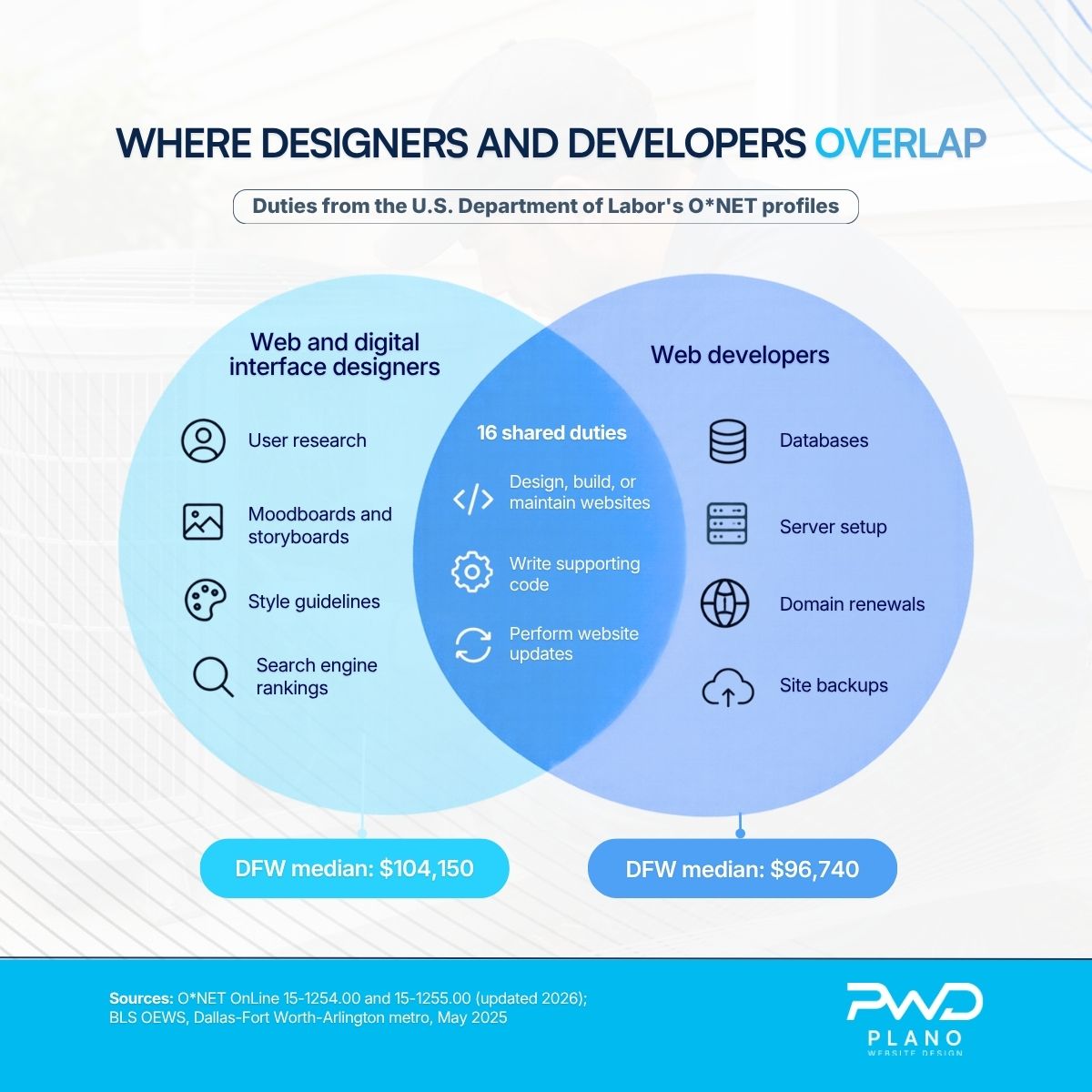
Choosing a web designer vs. web developer for small business work starts with the job, not the title. Federal O*NET data describes web and digital interface designers as the people who design interfaces, layouts, and navigation with a focus on usability and aesthetics, and web developers as the people who build and maintain websites, databases, and server-side code. The two task lists share 16 identical duties, so the titles blur in practice.
In the Dallas-Fort Worth-Arlington metro area, which includes Collin County, the Bureau of Labor Statistics put the May 2025 median annual wage at $96,740 for web developers and $104,150 for web and digital interface designers. A small business rarely needs either as a full-time hire. It needs a clear brief, a build where design lives in the theme and features live in plugins, and someone accountable for updates after launch.
Table of Contents
Two Job Titles That Share 16 Duties Word for Word
Ask five people in Frisco what a web designer does, and you’ll get five answers, and the government’s classification explains why. O*NET, the occupational database run by the U.S. Department of Labor, keeps separate profiles for web developers and web and digital interface designers, and 16 duties appear on both lists word for word.
Here’s how the two profiles describe the core of each job, and where they repeat each other:
| Web developers (15-1254.00) | Web and digital interface designers (15-1255.00) | |
|---|---|---|
| Summary | Develop and implement websites, web applications, application databases and interactive interfaces; optimize performance and server-side code | Design user interfaces or websites; develop and test layouts, functionality and navigation for usability across browsers and devices, with a focus on aesthetics |
| Tasks listed | 29 | 31 |
| Duties on both lists, word for word | 16, including “Design, build, or maintain Web sites”, “Write supporting code for Web applications or Web sites” and “Perform or direct Web site updates” | same 16 |
| Duties only on one list | Develop databases, install and configure HTTP servers, renew domain name registrations, back up site files | Create moodboards or storyboards, conduct user research, develop style guidelines, optimize webpages for search engine rankings |
| Sample reported job titles include | Web Developer, Webmaster, Web Design Specialist | Web Designer, UI Developer, UX Developer, Webmaster |
Look at the last row. “Web Design Specialist” shows up as a job title reported by web developers, and “UI Developer” as one reported by designers. When a freelancer calls themselves one or the other, it tells you less than their portfolio does.
Sixteen of the developer’s 29 listed tasks, more than half, are identical to tasks on the designer’s list. The education data differs a little. Among respondents O*NET surveyed, 52% said a new web and digital interface designer needs a bachelor’s degree, compared with 46% for web developers. Neither number tells you whether a particular person can build your site.
The Split WordPress Already Makes for You
If your site runs on WordPress, the platform’s own documentation draws the line between the two jobs more cleanly than any job title. The WordPress Theme Handbook’s page on what a theme is puts it in two lines: themes control the presentation of content, and plugins control the behaviors and features of your site.
That maps almost directly onto design and development work:
- Theme work is the look: colors, fonts, layout, templates, how a service page is arranged. This is where a designer’s decisions end up.
- Plugin work is the behavior: booking tools, payment processing, custom forms that feed a CRM, anything the business depends on to operate. This is developer territory.
The handbook adds a warning that matters to every business owner. A theme should not add site-critical functionality, because a user loses access to that functionality when they change their theme. If someone builds your quote calculator into the theme, the calculator disappears the day you redesign.
So one of the first questions to ask anyone you hire is simple: where will the features live? A good answer keeps them in plugins, so the next redesign changes the look without breaking the business.
What Each One Costs to Employ in Dallas-Fort Worth
Salaries only matter if you’re thinking about hiring someone in-house, but they explain a lot about what freelancers and agencies charge. The Bureau of Labor Statistics publishes metro-level wage estimates through its Occupational Employment and Wage Statistics program. Here are the May 2025 figures for the Dallas-Fort Worth-Arlington metro area:
| Occupation (BLS code) | Employed in DFW metro | DFW median annual wage | U.S. median annual wage |
|---|---|---|---|
| Web developers (15-1254) | 1,660 | $96,740 | $92,650 |
| Web and digital interface designers (15-1255) | 2,380 | $104,150 | $104,000 |
One thing stands out. Designers earn more than developers at the median, locally and nationally, which surprises people who assume code pays more than layout. The federal designer category covers user interface and user experience work, and the O*NET profile lists titles like UX Developer inside it.
Those figures are wages only. Benefits and equipment come on top, and one employee still covers one skill set. Compare that with our own published pricing, which puts a foundational 4- to 6-page business website at $3,500 to $6,000, a full-featured small business site with SEO setup at $6,000 to $15,000, and ecommerce or custom platforms from $15,000. That’s a one-time project, set against an annual salary.
A cheaper route exists, and it has its own costs. Before comparing quotes, check which basics the cheaper option leaves out. Our list of the website features a Plano small business needs is a quick way to run that check.
Which Kind of Help Does Your Project Actually Need?
Match the work to the skill. This is the table we’d use if a McKinney or Allen business owner asked us which person to call first.
| What you need done | Mostly design | Mostly development | Why |
|---|---|---|---|
| Refresh colors, fonts, and photos | Yes | Theme and brand decisions | |
| Rewrite and restructure service pages | Yes | Layout, navigation and content order | |
| A new 5 to 8 page brochure site | Yes | Some | Design leads; a developer sets up hosting, forms, and tracking |
| Online booking or scheduling | Some | Yes | A plugin, or a connection to an outside booking system |
| Taking payments or selling products | Some | Yes | E-commerce setup, tax and shipping rules, security |
| Moving to a new platform or domain | Yes | Redirects, data migration, server work | |
| Site is slow or keeps breaking after updates | Yes | Plugin conflicts, hosting and code | |
| Connecting forms to a CRM or email tool | Yes | Connecting systems and testing the handoff |
Notice how few rows are pure design. Anything that touches data, money, or a server needs a developer’s hands.
Rebuilds are where the gap shows
A redesign sounds like a design job, and the visible part is. The part that decides whether you keep your search traffic is a developer’s: mapping every old URL to its new home. We covered that in detail in the redirect plan a rebuild needs, and it’s the step most often skipped when a project is handed to a designer alone.
How Do You Check a Designer’s or Developer’s Work Before Hiring?
Ask to see the parts of a project that match the job, not just the finished homepage. A screenshot of a pretty site says something about design and almost nothing about development, and a list of technologies says something about development and nothing about whether visitors can find the phone number.
With a designer, the useful evidence is how they solved a layout problem. With a developer, it’s how the site behaves a year after launch.
| What to ask for | Designer | Developer |
|---|---|---|
| A live site they built, opened on your own phone | Is the call button easy to reach? Does the menu make sense? | Does it load quickly? Do the forms actually submit? |
| Earlier drafts or mockups | Shows how they handle feedback and revisions | Less useful |
| A style guide or design system | Shows consistency across pages | Less useful |
| The plugin list on a site they maintain | Less useful | Shows whether features sit in plugins or were built into the theme |
| Their update and backup routine | Ask if they offer it at all | Ask how often, where backups go, and when a restore was last tested |
| A site they rebuilt or migrated | Ask what changed visually | Ask how old URLs were redirected |
Accessibility is a fair test for both. The O*NET designer profile says designers may evaluate web design against web and accessibility standards, and both profiles list folding legal issues, including accessibility and privacy, into site plans. Ask each candidate how they check color contrast, form labels, and keyboard navigation. A designer should talk about contrast and layout, a developer about markup and testing, and anyone who says a plugin handles all of it hasn’t thought about it much.
References help too. Ask for a business owner in Plano, Allen, or McKinney whose site they have looked after for more than a year, and ask that owner who fixes things when they break.
Ownership, Updates and the Jobs Nobody Mentions
Ask who will own and maintain the site before you sign anything. O*NET’s web developer profile lists duties that never appear in a portfolio: backing up website files, renewing domain name registrations, performing site tests after revisions, and monitoring security logs. Somebody has to do them, and if the contract doesn’t say who, it’s probably nobody.
Run through this checklist with any designer, developer, or agency:
- Is the domain registered in your business’s name, on an account you control?
- Do you get the admin login and the hosting login on day one?
- Are features kept in plugins rather than built into the theme?
- Who applies WordPress, theme, and plugin updates, and how often?
- Where are backups stored, and has anyone tested a restore?
- Who renews the domain and the SSL certificate?
- What happens to the site files if the relationship ends?
Our answer to the ownership question is on our homepage: you own the domain, the hosting account, the design files, and the code. Whoever you hire, get the same answer in writing.
When One Person Is Enough, and When It Isn’t
A single freelancer can be the right call for a small, stable brochure site in Richardson that changes a few times a year. The 16 shared duties show how normal it is to work across both profiles.
Add booking, payments, or a migration, and one person now has to be strong at layout, code, hosting, and security at once. That’s where a team earns its fee: design, plugins, and upkeep covered by people who talk to each other. It’s the coverage behind our WordPress development team, from custom design and plugin work to WooCommerce stores and ongoing support. Our guide to web design for Plano businesses walks through each phase of a project.
Write the Brief, Then Choose a Designer, a Developer, or Both
Before you contact anyone, write one page: what the site must do, which pages it needs, what it connects to, who updates it after launch, and what the budget is. Mark each item as look, behavior, or both, using the theme and plugin split above. If most items are look, start with a designer. If several are behavior, you need development skills on the team from day one.
Then send the same brief to everyone you’re considering, including us at Plano Website Design, and compare answers to the ownership checklist as closely as you compare prices.