

Before you approve a logo, settle three things in writing: which files you receive, who owns the copyright, and whether you will register the logo as a trademark. Paying for logo design for a small business does not automatically make you the copyright owner. The US Copyright Office explains that a commissioned work only becomes a “work made for hire” in narrow cases, and a logo is not on its list. Trademark rights are a separate question again, handled by the USPTO for the whole country and by the Texas Secretary of State for Texas. This guide sets out what those documents say for a business in Plano or anywhere in Collin County, so the questions get asked before the final invoice.
We design logos and websites. We are not lawyers, and nothing here is legal advice. Where a question turns on your specific contract or a dispute, the agencies quoted below all say the same thing: talk to an attorney.
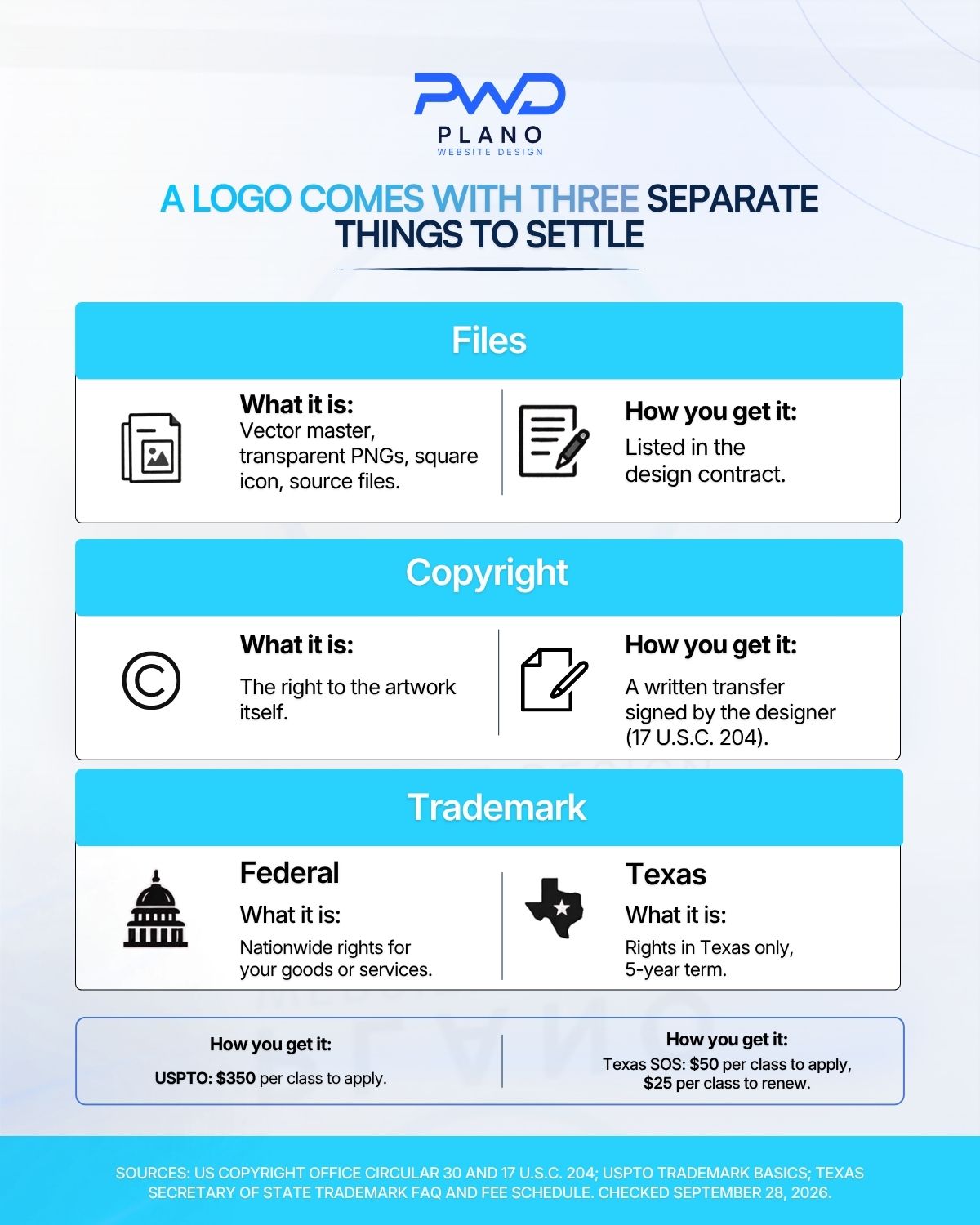
Three separate items come with a new logo. The files are what you use every day: a vector master, transparent PNGs, and a square icon for your website. The copyright belongs to whoever created the design unless the work is legally a “work made for hire” or the creator signs a written transfer; the US Copyright Office’s Circular 30 lists the nine kinds of commissioned work that qualify, and a logo is not one of them. The trademark is the right to stop confusingly similar marks on related goods or services. It starts with use, and registration strengthens it. Filing fees, per the USPTO and the Texas Secretary of State, are $350 per class for a federal application and $50 per class for a Texas registration that lasts five years.
The Files You Should Walk Away With
Start here, because files are what cause trouble first. A logo delivered as one JPEG in an email works until the day a sign shop, a T-shirt printer, or a web developer asks for something else.
| File | What it is for | Who asks for it |
|---|---|---|
| Vector master (SVG, AI, or EPS) | Scales to any size without blurring | Sign and vehicle wrap shops, printers |
| PNG with a transparent background, full color | Placing the logo over photos or colored areas | Web developers, social media tools |
| One-color and reversed (white) versions | Dark backgrounds, embroidery, single-color printing | Printers, embroiderers |
| Square icon version | Browser tab icon, social profile photos | Web developers, your social accounts |
| A short style sheet | Exact color codes and the typefaces used | Anyone who designs for you later |
Two of these have specific requirements from Google, because your logo shows up in search results as well as on your site.
The square icon for search results
Google’s documentation on favicons in Search says the icon must be square (a 1:1 aspect ratio) and at least 8×8 pixels, and it recommends going larger than 48×48 pixels so it looks good on different surfaces. The same page lists the file formats Google Search supports for favicons: BMP, GIF, ICO, PNG, JPEG, PPM and TIFF. A wide logo squeezed into a square is unreadable at that size, which is why a separate square mark is worth asking for up front.
The logo in your site’s structured data
If your developer adds Organization structured data to the home page, Google’s guidelines for the logo property say the image must be at least 112×112 pixels, crawlable and indexable, and should look the way you intend on a pure white background. A white or pale gray logo can disappear there. Our guide to schema markup for AI search covers where that markup sits on a small business site.
Ask for the editable source files too, not only exports. If the design was built in a program you do not own, you still want the files so a future designer can open them.
Who Owns the Copyright to a Logo You Paid For?
Under federal law, copyright “vests initially in the author or authors of the work,” in the words of Section 201(a) of the Copyright Act (17 U.S.C. 201). So the starting point is that the designer who created the logo owns it. Two ways to change.
Route one: work made for hire
The Copyright Office’s Circular 30, Works Made for Hire (revised August 2024) says a work is made for hire in two situations. The first is a work created by an employee as part of their regular duties. The second is a work specially ordered or commissioned under an express written agreement, but only if it falls into one of nine categories.
Those nine categories, as the circular lists them:
- A contribution to a collective work
- Part of a motion picture or other audiovisual work
- A translation
- A supplementary work
- A compilation
- An instructional text
- A test
- Answer material for a test
- An atlas
A standalone logo is not on that list. The circular ends with a seven-question flowchart, and question 7 asks whether the work falls into one of these categories; if not, its answer is “The work is not a work made for hire.” So a contract clause calling a freelancer’s logo a “work made for hire” may not do what the business owner thinks it does. Whether any specific contract works is a question for an attorney, and the circular itself says the Copyright Office cannot give legal advice about a work’s status.
If your own employee designed the logo as part of their job, the first situation applies instead, and the circular says the employer is the author and copyright owner.
Route two: a signed written transfer
For a logo from an outside designer or studio, ownership moves by assignment. Section 204(a) of the Copyright Act says a transfer of copyright ownership “is not valid unless an instrument of conveyance, or a note or memorandum of the transfer, is in writing and signed by the owner of the rights conveyed.” Note who signs: the owner of the rights, which means the designer.
A paid invoice is not that document. An email saying “it’s yours” may not be either. What the statute describes is a written transfer signed by the person who holds the copyright.
What to Put in Writing Before Design Starts
Here is the checklist we would want on any logo project, whoever designs it. None of it is exotic, and all of it is easier to agree on before the work begins than after.
- A written copyright assignment, signed by the designer, that takes effect on final payment
- Confirmation that the design is original, and that any purchased font or stock element is licensed for commercial use in a logo
- The full file list from the table above, including editable sources
- Whether the designer may show the logo in their own portfolio (a reasonable request, and better settled now)
- What happens to the drafts you rejected: who keeps the rights to them
- The number of revision rounds included, and the price of more
- The name of the legal entity that will own the logo, which should be your LLC or corporation if the business operates through one
That last point matters later. The Texas Secretary of State’s guidance says that when a business entity such as an LLC provides the goods or services under a mark, the entity owns the mark, not the individual owner. Put the assignment in the entity’s name so the paperwork lines up.
When we take on branding work, these points are part of the conversation from the first meeting, and you can see the kind of logo and website projects on our home page.
Owning the Copyright Is Not the Same as Owning the Trademark
Copyright covers the artwork. A trademark covers the logo’s job as a sign of who you are. The USPTO’s page on what a trademark is describes it as any word, phrase, symbol, design, or combination that identifies your goods or services and distinguishes them from competitors’.
Three points from that page surprise most owners:
- You become a trademark owner as soon as you use the mark with your goods or services: Those rights are limited to the geographic area where you do business.
- You do not own the design in general: A trademark protects the logo in connection with your specific goods or services, so a similar logo in an unrelated field may be allowed.
- Anyone may use TM or SM without filing: The registration symbol, an R in a circle, is only for marks registered with the USPTO, and only for the goods or services in that registration.
The USPTO also points out that its search database only covers federal applications and registrations. It encourages checking the internet, state trademark databases, and business name databases for similar marks, because someone may hold common law rights without ever registering.
A business name filing is not a trademark
This is the Texas trap. Many Plano and McKinney owners assume that forming an LLC or filing an assumed name certificate reserved their name. The Texas Secretary of State’s trademark FAQ answers that directly: filing a certificate of formation or an assumed name certificate “does not give you any rights to use a name in commerce.” Assumed names for sole proprietorships and partnerships are filed with the county clerk in each county where business is conducted, and that filing only records who is behind the business.
What Registration Costs, Federal Versus Texas
Registration is optional. Both agencies say so. It is also cheaper than most owners expect, as long as you count the renewals.
| USPTO (federal) | Texas Secretary of State | |
|---|---|---|
| Where rights apply | Throughout the United States and its territories | Texas only |
| Application fee | $350 base fee per class of goods or services | $50 per class |
| Before you apply | Can file on actual use or on a good-faith intent to use | Mark must already be in use in Texas |
| Upkeep | Maintenance filing after 5 years; every 10 years, $325 declaration of use plus $325 renewal, $650 per class | Registration lasts 5 years; renewal $25 per class, filed in the last 6 months |
| Recording a sale of the mark | Handled through the USPTO’s assignment process | Form 903, $25 |
The federal figures are from the USPTO’s page on trademark costs, which adds that further fees can apply depending on how complete and complex the application is, and that intent-to-use filings carry extra filings and fees. The Texas figures are from the Secretary of State’s trademark FAQ and fee schedule.
For a single-location service business in Frisco or Allen that plans to stay in Texas, a state registration is a modest cost. For a business that sells online or expects to open in Oklahoma or Arkansas, the USPTO notes that a state registration does not protect the mark across state lines.
Which Logos Are Hard to Protect?
Descriptive ones. According to the USPTO, strong trademarks are fanciful (invented words), arbitrary (real words unrelated to the product), or suggestive, while descriptive and generic terms are weak and often cannot be federally registered. Its examples of descriptive marks include “Creamy” for yogurt.
The Texas FAQ goes further for local businesses. Its list of marks that are not distinctive includes marks that are “primarily merely geographically descriptive” and marks that are primarily a person’s name. It also notes that such marks can become registrable with proof of distinctiveness, and that one common way to show it is five years of substantially exclusive and continuous use in Texas.
So a logo built around a town name plus a trade description may be hard to register, no matter how good it looks. The graphic element can still be distinctive. Keep that in mind when you brief a designer: a memorable symbol gives you more to protect than a nicer typeface on a descriptive name.
Opening soon? Our Frisco opening-day launch guide covers the order to lock in the name, domain, and listings, and the logo belongs on the same timeline.
Where the Logo Has to Match Everywhere
Once the logo is final, the same version should appear on your website, your Google Business Profile, your social profiles, and printed material. Mismatched versions look careless, and they make it harder for customers to connect a review on one platform with the business they saw on another. For social accounts in particular, the square version does most of the work, and our social media marketing team in Plano sizes it for each profile.
If you are rebranding an established business, keep the old files and a dated record of when the new logo went live everywhere. Owners of long-running businesses in McKinney and Richardson often find, years later, that an old logo is still on a directory listing they forgot about.
Get the Logo Assignment Signed Before the Final Payment
Put three items on your list before approving any logo: the file set, a signed copyright assignment in your business entity’s name, and a decision on trademark registration with the dates written down. If the designer is an employee, confirm in writing that the logo was part of their job. If the designer is a freelancer or a studio, the Copyright Office’s guidance points to a signed written transfer.
Then run a quick search of the USPTO database and the Texas trademark records for similar marks in your field before the logo goes on a truck or a sign. If anything close turns up, pause and talk to an attorney.
If you want the logo and the website built together, with the files and the paperwork sorted from day one, talk to Plano Website Design.
 FAQs