

Most Google Maps ranking hacks land in one of two piles. They do nothing, or they break Google’s rules. We checked eleven popular claims against Google’s published guidelines and independent tests. What holds up is plain work: the right primary category, accurate hours, a steady flow of honest reviews, real local links and a website that says clearly what you do and where. Geotagged photos don’t help. Keyword-stuffed business names do help, and they can get your profile suspended. Several things also changed in the past year, including how AI answers pick and display local businesses.
Is there a #1 spot on Google Maps?
No. Google ranks local results partly by how far each business is from the person searching, so the list changes from one part of town to the next. A Plano plumber can show first for someone a mile from the shop and be missing for someone searching from west Frisco.
That’s why searching your own service from your own office tells you very little. It shows one spot on the map, and it’s the spot where you look best.
A grid rank check fixes that. It runs the same search from dozens of points across your service area and maps your position at each one. You’ll see these sold as free. Check the math first. Local Falcon, one of the common tools, gives a new account 100 credits and charges one credit per map point. A 7-by-7 grid is 49 points, so three keywords cost 147 credits. At the pay-as-you-go rate of five cents a credit, covering the other 47 comes to about $2.35 (pricing as of November 2026). It’s cheap, but it isn’t free.
The no-cost version: drive to three neighborhoods you want work from, search your main service on your phone, and screenshot what you see.
What does Google say decides Maps rankings?
Google names three things on its local ranking help page: relevance, distance and prominence. One sentence on that page calls the third one popularity.
- Relevance is how well your profile matches the search. Google says complete, detailed business information helps.
- Distance is how far you are from the searcher.
- Prominence is how well known your business is. Google says it’s based partly on how many websites link to you and how many reviews you have, and that more reviews and positive ratings can help.
The same page says there is no way to request or pay for a better local ranking.
That’s close to everything Google confirms. The rest of what the industry knows comes from two places: controlled tests, and Whitespark’s Local Search Ranking Factors survey, in which 47 local search experts scored 187 factors for the 2026 edition. The survey is informed opinion from people who do this work every day. It is not Google’s word. We say which source we’re leaning on each time.
The scorecard: eleven claims, checked
| The claim | Verdict | Why |
|---|---|---|
| You can rank #1 on Google Maps | Misleading | Results change with where the searcher is standing. There’s no single position to hold. |
| Geotagged photos boost your ranking | Myth | Tests found no effect, and experts rate it last of 187 factors. |
| Keywords in your business name boost your ranking | Works, and breaks the rules | Experts rate it third of 187 factors. Google says it can get you suspended. |
| Your primary category is the biggest profile decision | Holds up | It’s the top factor in the 2026 expert survey. |
| Listing 20 service-area cities ranks you in all 20 | Myth | Google allows 20 areas. Distance from the searcher still decides a lot. |
| Your hours affect where you rank | Holds up | Being open at the time of the search places fifth in the expert survey. |
| More Google reviews help | Holds up | Google says so on its own ranking page. |
| A discount for a review is fine | Breaks the rules | Google’s policy and the FTC’s reviews rule both ban it. |
| Weekly posts and photos move you up the map | Mostly myth | Google doesn’t credit them with ranking. They help people choose you. |
| Schema markup boosts your Maps ranking | Overstated | Google says it helps display your details and guarantees nothing. |
| A cheap backlink package builds prominence | Breaks the rules | Google’s spam policies treat paid links as link spam. |
Which claims hold up?
Your primary category
The experts in the Whitespark survey put primary category first out of all 187 factors. Google’s guidelines give you the test for picking one: choose the category that finishes the sentence “this business IS a,” and use as few categories as you need to describe your core business. Look at what the top three results for your main service use, then pick the most specific category that is true for you.
Change it once and on purpose. Google says that changing some business information can mean verifying your profile again.
Your hours
This one surprises people. “Business is open at the time of search” places fifth in the same survey. If you close at 5 and a competitor answers the phone until 8, the evening searches may go to them.
The fix is not to list 24 hours and let calls go to voicemail. Google’s guidelines ask for your real customer-facing hours. If you can truly staff longer hours, list them. If you can’t, don’t.
Reviews, asked for the right way
Google says outright that more reviews and positive ratings can help your ranking. A high rating and the number of reviews with written text both sit in the survey’s top ten.
How you ask matters as much as how often. Google’s review policy bars all of the following:
- Offering payment, discounts, or free goods or services for a review
- Asking only your happy customers, or discouraging negative reviews
- Pressuring customers to leave a review while they’re on your premises
- Telling staff to collect a set number of reviews
- Asking for specific content, including the name of a staff member
So ask every customer, the same way, for an honest review, and send the link after the job is done. Our guide on how to get Google reviews covers the mechanics.
Real local links
Links are the other thing Google names under prominence. For a local business that means a chamber of commerce listing, a sponsor page for a youth league, a manufacturer’s dealer locator or a write-up in a local news outlet. One of those in a month is a good month.
Which hacks are myths?
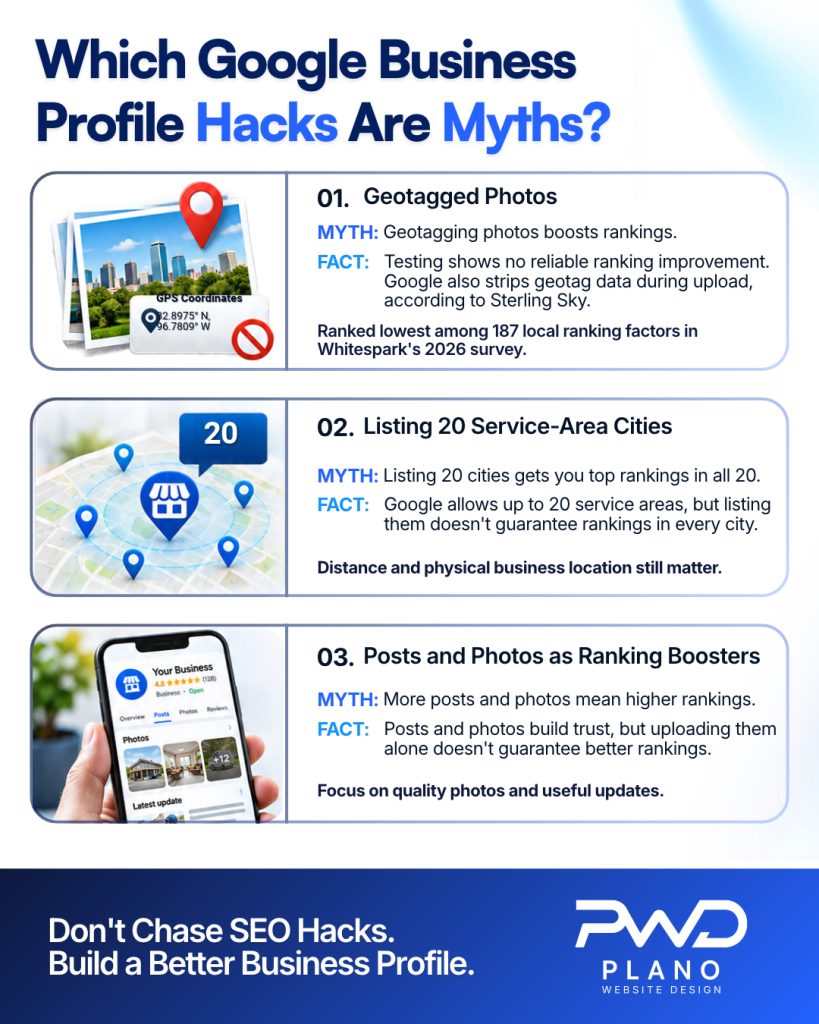
Geotagged photos
Geotagging means adding GPS coordinates to a photo file before you upload it. It’s sold as a ranking trick, and it doesn’t work. Sterling Sky tested it on five business profiles and saw no measurable change, as Search Engine Land reported. Whitespark points out that Google strips that data from photos uploaded to a profile. In the 2026 survey, geotagged photos came in dead last, 187th of 187.
Twenty service-area cities
Google lets a service-area business list up to 20 service areas. Listing them tells customers where you work. It doesn’t put you at the top in all 20. Closeness to the searcher and having an address in the city being searched are second and fourth in the expert survey, and a list of city names changes neither.
The survey also rates a visible address as a top-ten factor, which leaves service-area businesses that hide their address at a disadvantage. That’s frustrating, and it isn’t a reason to fake a storefront. More on that below.
Posts and photos as ranking levers
Google’s ranking page recommends adding photos to show customers what you offer. It doesn’t say photos affect ranking, and it doesn’t mention posts at all. When Sterling Sky tested adding photos to four business profiles, local pack rankings didn’t measurably move.
Keep doing both anyway. A profile with last week’s job photos and a current offer wins the call when a customer is comparing you with two other companies. Just don’t expect the upload itself to move you up the list.
Which hacks work and can get you suspended?
This is the part most playbooks soften. Some rule-breaking tactics do move rankings. That’s why people keep using them.
Keywords in the business name
Experts rate keywords in the business name third of 187 factors. Google’s guidelines say your name must match the one on your signage and website, and they list taglines, service descriptions, location details and phone numbers as things that don’t belong in it. The same page says extra name information can result in suspension.
Our view: a stuffed name is a ranking you’re renting until somebody reports it. If “Plano” or “Roofing” truly belongs in your name, change the name for real, on your signage, your website and your paperwork. Otherwise leave it alone.
Addresses you don’t work from
Google says a rented mailing address where the business doesn’t operate, often called a virtual office, isn’t eligible for a profile. PO boxes aren’t accepted. A co-working space counts only if it has clear signage, receives customers during business hours, and is staffed by your own people during those hours.
Review schemes
Paying for reviews breaks Google’s policy, and since October 21, 2024, it also runs into the FTC’s rule on consumer reviews. That rule bans buying reviews, paying for reviews of a particular sentiment, undisclosed insider reviews, and suppressing negative ones, and it lets the agency seek civil penalties.
Bought links
Google’s spam policies classify paying for links as link spam. The $50 package of 1,000 backlinks belongs in the same bin as the geotagging software.
What does your website have to do with a Maps ranking?
More than most profile-only checklists admit. Your site is where Google and AI tools read what you do and where, and links to it feed prominence. Four things matter most.
The page your profile links to
Put your main service and your city in the title and the main heading, and show the same name, address and phone number your profile shows. A single location should usually link its profile to the homepage.
A page for each service
AC repair, AC installation, and furnace repair are three searches, so give them three pages. Each one should explain the service, show real job photos, and make it easy to call.
City pages only when they’re real
Google’s spam policies describe doorway abuse as pages created to rank for specific, similar searches, and they give city-targeted pages that funnel visitors to one destination as an example. If your Allen page is your Plano page with the city name swapped, don’t publish it. Build a city page when you have jobs, photos, and reviews from that city to put on it.
Schema and AI crawler access
Google says LocalBusiness structured data helps it show details such as your hours in Search and Maps. It requires a name and address, recommends the most specific business type available, and guarantees nothing. Schema is a clear label on your business details, and it won’t rank a weak page. We cover the setup in schema markup for AI search.
Then check that AI tools can reach your site at all. OpenAI’s crawler documentation says sites that opt out of its search crawler, OAI-SearchBot, won’t be shown in ChatGPT search answers. A robots.txt file is one place a block can live. Hosting firewalls and security plugins can turn bots away too, and a site owner rarely sees it happen. Ask your developer to test both. Our guide on how to show up in ChatGPT answers goes deeper.
What changed in the past year?
Advice from early 2025 is already stale in a few places.
- Q&A is gone: Google shut off the Q&A API on November 3, 2025 and confirmed that December that an AI-powered Ask feature in Maps would replace it. BrightLocal reports that the answers draw on your profile information, your reviews and your website. Put your top customer questions and answers on your own site.
- AI Mode can book home services: On November 4, 2026, Google added booking links for home services to AI Mode in the U.S. through Angi, Thumbtack, Housecall Pro and Jobber, with ServiceTitan to follow.
- Google is testing a stripped-down local pack: On November 10, 2026, Search Engine Roundtable reported a test of an AI Overview version of the local pack without action buttons, reviews or photos. It’s a test and may not last. It’s also a reminder not to depend on one button.
- Apple and Bing moved: Apple Business replaced Apple Business Connect in April 2026, and Bing Places moved to bing.com/forbusiness in October 2025 with a simpler import from Google. Claim both. Whitespark notes that three of the top five factors for AI search visibility in its 2026 survey are citation factors, meaning consistent listings on other sites.
What we don’t promise
We don’t guarantee a map position, and nobody can. Google says in writing that you can’t request or pay for a better local ranking, and it changes its systems without notice. What we can do is tell you which fixes are worth your time, which ones are placebo and which ones put your profile at risk. That’s what this post is.
Where to start
Run a grid check or the three-neighborhood phone test so you know where you stand. Confirm your primary category and your hours. Set up one review request that goes to every customer after every job. Then look hard at the page your profile links to.
If your profile is in good shape and you still aren’t showing up, our walkthrough of Google Business Profile optimization and our post on why a business doesn’t show on Google Maps are the next reads.
If you’d rather have someone check it for you, the free AI Search and SEO Audit covers your Google profile, your website and your listings, and you get the findings either way. You can also see how we handle local SEO in Plano.
Plano Website Design. 7950 Legacy Drive, Suite 400, Plano, TX 75024. 469-375-9656.